FBI Raid Exposes Massive Miami-Dade Cockfighting Operation: Thousands of Roosters Found
Miami-Dade, Florida | 11 October 2026 The Gamblers Den · Underground Gambling & Animal Cruelty
Two men face charges after a federal raid uncovered thousands of roosters and equipment associated with organized cockfighting on a sprawling South Florida property.
Illustration of law enforcement investigating a suspected cockfighting operation.
Thousands of Roosters Discovered
A federal investigation in Southwest Miami-Dade uncovered a suspected large-scale cockfighting operation involving thousands of roosters, specialized equipment and allegations of animal cruelty. FBI agents encountered the suspected operation while pursuing a separate investigation and alerted local authorities.
Investigators examined a roughly 10-acre property in the 12300 block of Southwest 51st Street, where they reportedly found numerous gamefowl and equipment associated with training birds for fights.
Fighting Equipment and Training Rings
Detectives reported discovering enclosed training rings, fighting spurs, syringes, medications, vitamins and other materials. The number of birds and amount of equipment suggested an operation substantially larger than a casual backyard event.
The scale of the suspected animal-fighting operation is documented; the size of any associated gambling business has not been established publicly.
Two Arrests Following the Raid
Carlos Rafael Lezcano, 52, was arrested on October 4 after investigators said two men fled a secured area of the property when confronted. Authorities reportedly recovered a ledger bearing his name. He faces charges relating to animal fighting, animal cruelty, evidence tampering and resisting an officer without violence.
A second man, Sergio Ruiz-Osorio, 54, was arrested on October 7 following further investigation of the property. He faces felony allegations involving possession of animals for fighting and animal cruelty. Both men are presumed innocent unless proven guilty.
Other Animals Found in Poor Conditions
Investigators also found dogs, cats, goats, turtles and additional birds on the property. Reports described inadequate food and water for some animals. Miami-Dade Animal Services and animal welfare responders assisted with their removal and care.
Cockfighting and Underground Wagering
Organized cockfighting events can attract illegal wagers on the outcome of fights, while exposing animals to severe injury and death. Such events operate outside legal gaming oversight and animal-welfare safeguards.
However, investigators have not publicly confirmed betting totals, gambling proceeds or a wider money-laundering network in this Miami-Dade case. The reported charges primarily concern animal fighting and cruelty.
Florida's Enforcement Challenge
Florida prohibits organizing and participating in animal fighting and possessing animals for fighting purposes. The investigation illustrates how large rural properties can conceal alleged operations involving numerous animals and extensive equipment.
The Gamblers Den
The Miami-Dade raid shows how one law-enforcement inquiry can expose an entirely different alleged underground enterprise. While authorities pursue criminal charges and care for seized animals, questions remain about the operation's duration, organization and financing.
UNDERGROUND BETTING HAS A DARK SIDE—AND IN ANIMAL FIGHTING, THE COST IS PAID BY THE ANIMALS.
Last Casino on Earth Episode16: Cape Town: The Eco-Crime Casino
Macau Under a Toxic Haze: Air Quality Alert Exposes Growing Climate Risks to the Casino Capital
Macau | 10 October 2026 The Gamblers Den · Environment & Casino Industry
Macau's meteorological bureau warns of deteriorating air quality, raising concerns for residents, tourists and the casino capital's long-term environmental resilience.
Illustration: Macau's casino skyline under a polluted sky.
Air Quality Warning Across Macau
Macau's Meteorological and Geophysical Bureau (SMG) warned of moderate to bad air quality for October 9, with forecast index readings of 75 to 110 and Taipa Grande expected to experience particularly poor conditions, according to the Macau Daily Times.
People with respiratory or cardiovascular conditions, older residents, children and others sensitive to pollution may face greater health risks. Reducing strenuous outdoor activity during pollution episodes can help limit exposure.
The Hidden Environmental Cost of Casino Tourism
Macau's gaming economy relies on constant movement of visitors, employees, buses, taxis and deliveries across a compact urban area. Traffic emissions, regional pollution and weather conditions can contribute to poor air quality. The latest SMG alert does not establish that casino operations caused this episode.
While gaming floors are indoors, integrated resorts still depend on air filtration, ventilation, transportation networks and reliable power. Pollution alerts can complicate outdoor activities and heighten concern for workers and visitors.
Climate Change: A Bigger Threat to the Gambling Capital
Macau also faces longer-term exposure to coastal flooding, typhoons, extreme rainfall and rising seas. These risks could damage transport links and utilities, disrupt resort operations and raise the cost of protecting waterfront infrastructure.
Climate change should not be presumed to have caused this specific air-quality event. Air pollution and coastal climate hazards are distinct, sometimes overlapping environmental challenges.
Cleaner Vehicles, Difficult Regional Challenges
Macau has been preparing stricter vehicle exhaust-emission limits, including requirements affecting motorcycles and diesel vehicles. Such measures can address local pollution sources, although pollution transported from elsewhere in the Pearl River Delta also complicates the city's air-quality picture.
Casino Operators Face a New Category of Risk
Macau's casinos are accustomed to managing tourism cycles, regulatory changes and competition. Environmental resilience adds another dimension: better filtration, flood protection, backup power and emergency plans may become increasingly important investments. These are potential responses, not requirements imposed by the October 9 alert.
The Last Casino on Earth?
Macau's glittering casino towers project an image of uninterrupted luxury. Beyond the gaming floors, however, polluted air, severe storms and rising waters are reminders that the city is exposed to forces no gaming operator controls.
THE HOUSE ALWAYS WINS—UNTIL THE CLIMATE CHANGES THE ODDS.
Last Casino on Earth Episode1: Macau Some Games Never Die
White House Insider Bet? Kalshi Examines Suspicious Wagers on Trump Press Secretary Pick
Washington, D.C. | 10 October 2026 The Gamblers Den · Prediction Markets
Three unusually timed bets totaling $173 reportedly stood to return approximately $9,608 after a surprise White House personnel decision. Kalshi is examining whether traders had an improper informational advantage.
Illustration of political prediction-market trading. Suspicious activity does not establish insider misconduct.
The Long Shot That Paid
According to reporting by The Wall Street Journal, Kalshi began examining bets placed ahead of the announcement of Katie Zacharia as President Donald Trump's choice for White House press secretary. Zacharia had been regarded as an unlikely selection, making wagers on her appointment potentially lucrative.
The Journal identified three noteworthy bets: $19 reportedly positioned for a $1,896 payout, $74 for $3,689, and $80 for $4,023. Together, the $173 in wagers were positioned for roughly $9,608 in gross payouts—about $9,435 above the original stakes, if settled as described.
Unusual timing is a reason to investigate—not proof that any trader received confidential information.
When a Government Secret Has a Market Price
Political event contracts turn public uncertainty into prices. A contract trading at a very low probability can produce an outsized return if the unlikely outcome occurs. But presidential appointments are decided by a small circle of people who may know the result before the public does.
That creates a fundamental integrity challenge: a trader using public clues and judgment competes on different terms from someone with advance access to confidential government decisions.
What Investigators Need to Know
Kalshi can examine account records and transaction histories to assess who traded, when orders were entered, and whether trading patterns suggest coordination. Investigators would still need evidence connecting the trades to improperly obtained information before concluding that prohibited conduct occurred.
The identities and motives of the traders have not been established publicly in the reporting cited here. No finding of illegal insider trading should be inferred from the potential payouts alone.
Prediction Markets Under Scrutiny
Supporters say prediction markets aggregate information and provide timely estimates of likely outcomes. Critics worry that contracts tied to official decisions can reward access to nonpublic information. The Commodity Futures Trading Commission oversees federally regulated event-contract markets, but the legal analysis of any particular trade depends on the applicable rules and evidence.
The Gamblers Den
On a casino floor, a long-shot bet is part of the game. In a political prediction market, the central question is whether everyone is playing with the same access to information. Three small wagers may now become a test of how effectively event exchanges police that boundary.
For now, the case remains an investigation, not a verdict. The most important unanswered question is whether the traders made an extraordinary prediction—or knew the answer in advance.
Last Casino on Earth Episode10: World Street Prediction Market
UK Gambling Tax Hike Threatens Regulated Operators as Blackmarket Fears Grow
United Kingdom | 9 October 2026 The Gamblers Den
Higher gambling duties could squeeze licensed betting companies while making offshore, unlicensed competitors more attractive to price-sensitive customers.
A Tax Squeeze on the Legal Market
The British gambling industry faces renewed pressure as policymakers consider higher taxes on regulated gambling. Licensed operators argue that a heavier tax burden could reduce investment, narrow consumer offers and weaken their ability to compete with unlicensed offshore websites.
The precise impact depends on the rates enacted, which gambling products they cover, and how operators respond. A tax increase does not automatically produce a corresponding rise in illegal betting.
Why the Blackmarket Matters
Regulated operators must comply with licensing rules, identity checks, anti-money-laundering controls and safer-gambling requirements. Unlicensed sites operating outside British oversight may avoid some of these costs and protections.
If higher duties lead licensed companies to offer less competitive prices or fewer promotions, some customers may look elsewhere. The size of any migration remains uncertain and needs evidence rather than assumption.
Revenue Versus Consumer Protection
Supporters of higher gambling taxes see an opportunity to raise public revenue and make an industry associated with social harm contribute more. Critics warn that a tax policy designed around short-term receipts could undermine the regulated market that government can supervise.
The policy challenge is to balance tax revenue, gambling-related harm and effective enforcement against illegal operators.
The Gamblers Den
The central question is not simply how much the Treasury can collect from licensed gambling. It is whether the legal market remains competitive enough to keep customers within enforceable consumer safeguards.
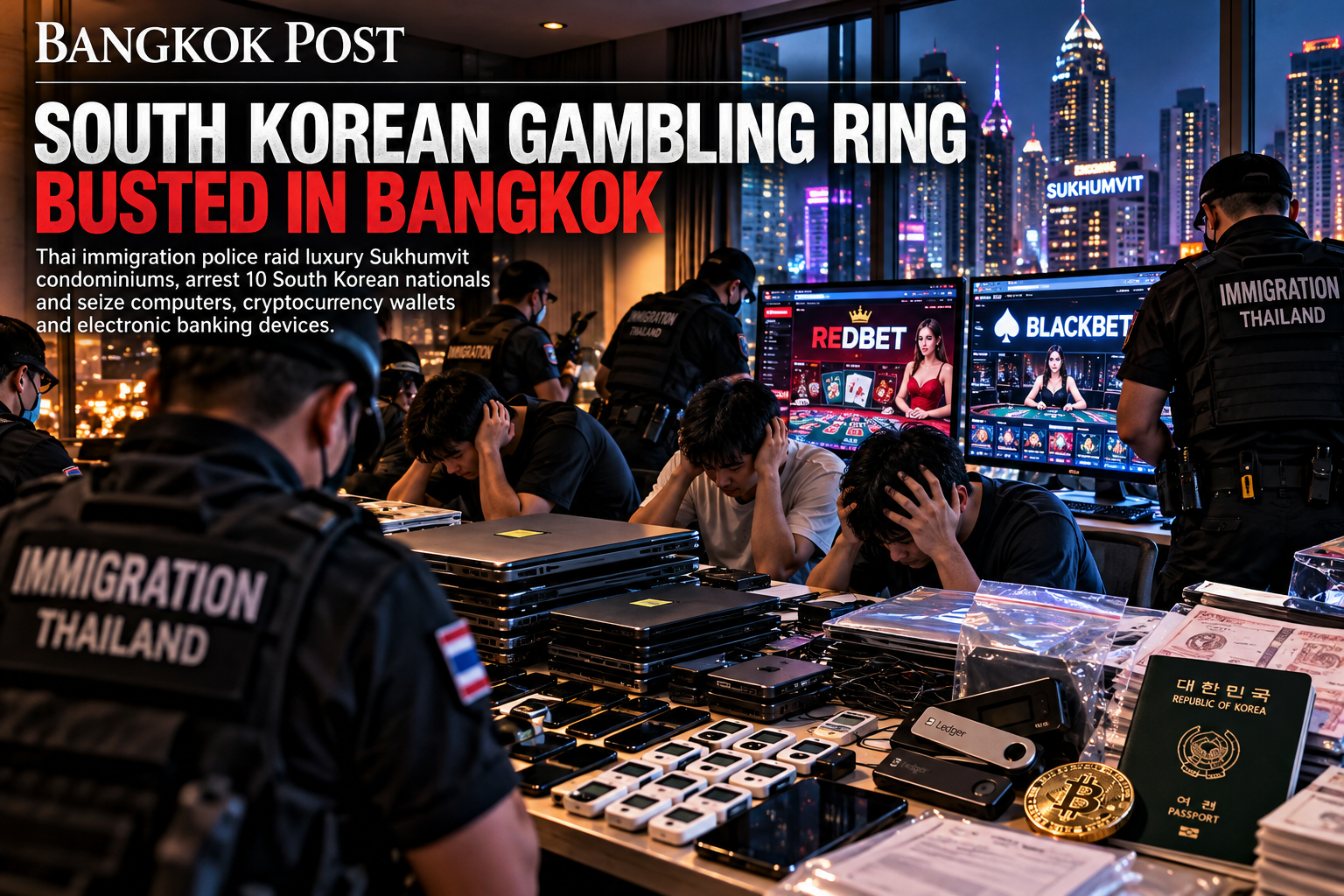
South Korean Gambling Ring Busted in Bangkok: Ten Arrested in Sukhumvit Condo Raids
Bangkok, Thailand | 9 October 2026 The Gamblers Den
Thai immigration police arrested ten South Korean nationals suspected of administering online gambling websites from luxury Bangkok condominiums.
Condominium Offices Behind the Screens
Thai authorities raided condominium units in Bangkok’s Sukhumvit district as part of an investigation into an alleged South Korean online gambling network. Investigators reportedly identified websites called Redbet and Blackbet.
Police said four South Korean suspects were found at one location and six at another. Their alleged roles included administering websites and monitoring customer deposits and withdrawals.
A Huge Reported Transaction Flow
According to the Bangkok Post report, investigators linked the operation to more than 1.5 million registered accounts and transaction activity exceeding 500 million baht per month. These are reported figures, not independently audited revenues or profits.
The alleged operation illustrates how a relatively small number of administrators can support a far larger remote gambling business.
Computers, Phones and Crypto Wallets Seized
Officers reportedly seized 32 laptop computers, 31 one-time-password devices, 30 mobile phones and two hardware cryptocurrency wallets. Investigators may use electronic and financial records to reconstruct how the sites operated.
The presence of cryptocurrency wallets does not, by itself, establish laundering or prove how customer payments were processed.
Cross-Border Enforcement
Thai and South Korean authorities cooperated in the investigation. Thai officials reportedly revoked the suspects’ visas and began deportation procedures. The allegations have not been established by a criminal conviction.
The case demonstrates how an online gambling business can target customers across borders while concentrating its administrative personnel in residential properties.
The Gamblers Den
A digital casino still needs people, devices and payment infrastructure. Even when the betting takes place online, investigators can follow the equipment and financial records back to a physical address.
Last Casino on Earth Episode5: Pyonygang Squid Games.
Vegas Showgirl Scam Turns Violent: Tourists Attacked Over a $20 Tip
Las Vegas | 8 October 2026 The Gamblers Den
A souvenir photograph on the Las Vegas Strip allegedly became a violent confrontation after costumed showgirl impersonators demanded more than a $20 tip. A separate complaint raised questions about mobile-payment overcharging.
Illustration of Las Vegas showgirl impersonators and tourist confrontation
Feathers, Fists and a Disputed Tip
Two North Carolina tourists posing for photographs with costumed performers near Planet Hollywood became embroiled in a confrontation after a dispute over payment, according to reporting on a Las Vegas police investigation. The visitors said they offered a $20 tip; one performer allegedly demanded considerably more.
Police accused two women of battery following the encounter. The tourists described being struck, and investigators reportedly reviewed surveillance footage. The suspects disputed the tourists’ accounts, with one claiming a tourist was the initial aggressor. The allegations have not been adjudicated.
A Separate Debit-Card Complaint
Investigators also examined a separate allegation that a customer who agreed to a $60 photo payment was charged $218 through a mobile tap-to-pay transaction. That allegation is distinct from the physical confrontation.
Mobile payments make street transactions convenient, but visitors should always verify the displayed total before authorizing a charge.
The Street-Performer Economy
Showgirl-style costumes evoke Las Vegas’s historic casino revues, but independent sidewalk performers are not necessarily affiliated with any casino or theatrical production. Many work legitimately for tips; allegations against particular individuals should not be generalized to the wider community.
The case highlights a simple tourist precaution: agree on any photo fee before posing, keep control of payment cards, and seek security or police assistance if a dispute becomes threatening.
Grosvenor Casino Group Agrees £5 Million Settlement Over AML and Safer Gambling Failures
United Kingdom | 8 October 2026 The Gamblers Den
The UK Gambling Commission has announced a £5,012,261 regulatory settlement involving Rank Group’s casino businesses after finding weaknesses in money-laundering controls and customer protection.
UK casino money laundering compliance investigation illustration
Fifty-One Casinos Under the Spotlight
The regulator said Grosvenor Casinos Limited, Grosvenor Casinos (GC) Limited and Gaming Group Limited, all owned by Rank Group, operate 51 casinos across Great Britain. Its review identified failures in anti-money-laundering procedures and social responsibility controls.
The settlement is a payment in lieu of a financial penalty, rather than a criminal conviction or proof that particular casino customers laundered money.
High-Risk Funds, Weak Checks
Among the deficiencies cited were outdated AML policies, inconsistent treatment of higher-risk customers, insufficient scrutiny of risky sources of funds and failures to conduct enhanced due diligence when required.
The findings show why compliance is not merely a paperwork exercise: casinos must understand customer risk and apply meaningful checks consistently.
Warnings Missed as Customers Lost Thousands
The Gambling Commission described customers who were not given appropriate safer-gambling interventions, including one who lost £50,000, another who won about £260,000 before losing roughly £250,000 over 12 days, and a customer returning from self-exclusion who lost £25,000 before an intervention.
The group has committed to an independent third-party audit. The settlement funds are to go to the government’s Consolidated Fund.
The Gamblers Den
Online casinos often dominate enforcement headlines, but cash-intensive physical gaming venues face their own substantial financial-crime and consumer-protection risks. The regulator’s message is clear: a casino floor is no exemption from rigorous scrutiny.
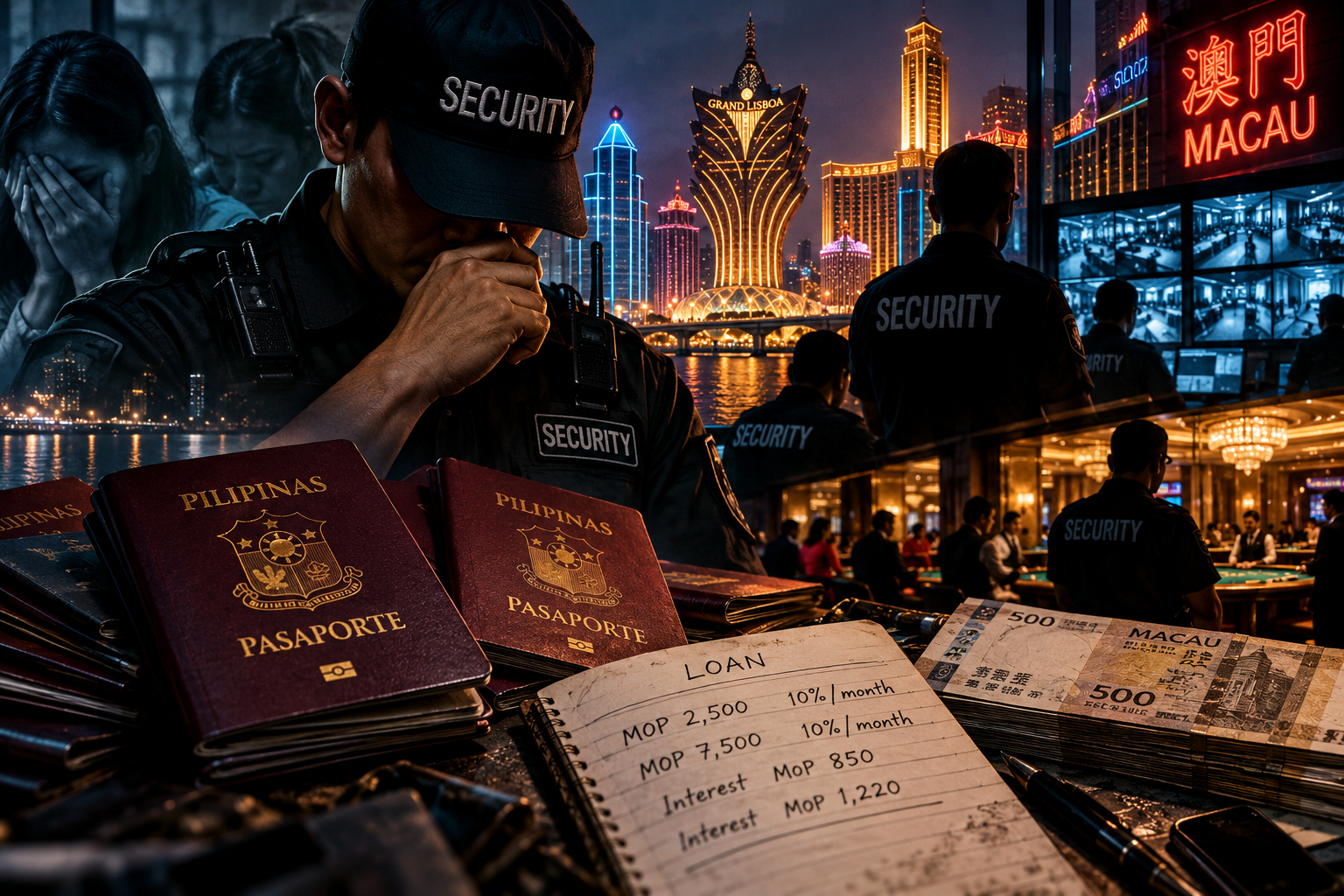
Macau Security Guard Accused of Illegal Lending and Holding Workers’ Documents
Macau | 8 October 2026 The Gamblers Den
Macau police arrested a 32-year-old Filipino security guard suspected of making high-interest loans to two fellow migrant workers and retaining their identity documents as collateral.
Illustration of private security lending scam in Macau
Loans With a Hidden Cost
According to Macau Daily Times, the Judiciary Police investigated allegations that a male security guard lent MOP2,500 and MOP7,500 to two Filipino women employed as non-resident workers. The lender allegedly charged interest and held their identification documents as security.
A separate Chinese-language report in Macau Daily described a monthly interest rate of 10 percent. The two women reported paying substantial interest while the principal remained due.
Police Make an Arrest
Following complaints from the women, police detained the suspect in Areia Preta. Investigators referred the matter to prosecutors on suspicion of profiteering and improper retention of documents. These are allegations, not a conviction.
When Debt Becomes Control
Retaining a borrower’s passport or identity papers can give a lender leverage beyond the amount owed. For migrant workers, access to documents is closely connected to mobility, employment and the ability to seek help.
The reported case concerns a security guard and private loans; it does not establish that a casino operator or licensed security company organized the alleged scheme.
The Gamblers Den
Macau’s reputation as a high-stakes gaming center often draws attention to casino credit and VIP junkets. But financial coercion can also occur far from the gaming tables, through informal loans between workers. The investigation illustrates why the protection of identity documents matters as much as the policing of interest rates.
The Whistle, the Odds and North Korea: Why Women’s Soccer Has an Officiating Problem
International | 7 October 2026 The Gamblers Den
Women’s soccer is becoming bigger business, and the referee is becoming a measurable part of the risk. From disputed cards in North-South Korean matches to VAR, betting markets and new referee-impact analytics, a single whistle can alter tournament advancement, prize money, national prestige and the odds.
As women’s soccer grows commercially, high-impact officiating decisions increasingly intersect with tournament stakes, analytics and betting markets.
Women’s soccer is attracting larger audiences, greater sponsorship, richer international competitions and expanding betting markets. That makes one participant increasingly difficult to treat as an invisible variable: the referee.
A penalty can transform win probability in seconds. A red card can destroy a tactical plan and move a betting line. A disputed decision can determine who advances through a tournament. On the Korean Peninsula, those stakes are magnified by national prestige, political symbolism and the resurgence of North Korea as a major women’s football power.
The “Girl’s Day” Controversy
A controversy erupted in South Korea’s WK League during an August 2026 match between Suwon FC Women and Seoul City Hall. South Korean star Ji So-yun protested what she believed were repeated rough challenges. During communications among officials, an expression translated as “Girl’s Day” — a euphemism referring to menstruation — was reportedly used in connection with someone being sensitive.
Ji confronted referee Bae Seon-young and received a yellow card. The official disputed the interpretation that the remark was specifically directed at Ji. That distinction matters: an allegation is not proof of discriminatory intent. But the episode raised a larger institutional question about accountability when the person controlling discipline on the field becomes the subject of the complaint.
A player can protest a decision. The referee can reach for a card. That imbalance of authority makes transparency and professional standards essential.
Korea Has Been Here Before
At the 2023 Hangzhou Asian Games, South Korea faced North Korea in the women’s quarterfinal. With the score tied 1-1, South Korean forward Son Hwa-yeon received a second yellow card after contact with North Korean goalkeeper Kim Un-hui while pursuing the ball. South Korea played more than half the match with ten players and ultimately lost 4-1.
South Korean coach Colin Bell publicly argued that the dismissal had destroyed the match, while Ji said officiating had influenced the contest too heavily and questioned whether an earlier North Korean challenge might have produced a red card if VAR had been available. Those comments were the South Korean side’s assessment, not a finding that the referee was biased.
From an analytics perspective, however, the dismissal is exactly the kind of event that deserves measurement: a tied knockout match, one team reduced to ten players, and a major subsequent change in the expected result.
The Stakes for North Korea
North Korean women’s soccer makes the officiating question unusually consequential. The national team has won multiple Asian Games titles and remains one of Asia’s strongest sides. In the 2026 Asian Games group stage, North Korea and South Korea drew 1-1, with North Korea taking first place in the group through superior goal difference.
That distinction affected the tournament path. In a short international competition, a goal, card, penalty or disputed whistle can influence not only one match but the bracket, travel demands and the opponents a team faces next.
The financial stakes are rising as well. North Korean club Naegohyang Women’s FC defeated South Korea’s Suwon FC Women in the AFC Women’s Champions League semifinal and went on to win the continental title. The championship brought major prize money and qualification for global competition.
For North Korea, a high-leverage decision can affect tournament advancement, international qualification, prize money, national prestige and politically sensitive competition with South Korea.
The Whistle Can Move the Odds
Sportsbooks convert information into probabilities. Team strength matters. Injuries matter. Home advantage, weather and starting lineups matter. Referees can matter too.
A penalty changes expected goals. A red card changes the expected performance of both teams. Yellow cards can force defenders to become less aggressive. Added time creates more opportunities to score. An official who allows heavy physical contact creates a different match environment from one who whistles it immediately.
As women’s soccer becomes a larger betting product, referee assignments and referee tendencies become potentially valuable information. The relevant question is no longer merely whether supporters like an official. It is: how much is the referee worth in the line?
Sabermetrics Comes for the Referee
Baseball’s sabermetrics revolution turned supposedly intuitive characteristics of players into measurable events. Basketball analytics extended that philosophy to lineups, possessions and eventually officiating.
A 2026 NBA analytics study proposed a Referee Impact Metric (RIM) using ESPN win-probability data. Its key insight is that not every whistle has equal value. A foul during a 20-point second-quarter blowout may barely affect the expected winner. A whistle with seconds remaining in a tied game can change everything.
RIM therefore focuses on the movement in win probability associated with officiating events instead of treating every foul as equivalent. That separates referee activity from referee impact.
Build RIM for Soccer
Women’s soccer could apply the same approach. Call it a Football Referee Impact Metric — FRIM.
Suppose a match is tied late in the second half. Before a penalty decision, one team has a 42% probability of winning. After the decision, its probability rises to 71%. The whistle has produced a 29-percentage-point swing in the expected outcome.
FRIM would not automatically declare the decision wrong. It would identify the decision as highly consequential. Over thousands of matches, researchers could measure the impact of penalties, red cards, second-yellow dismissals, disallowed goals, VAR reversals and critical stoppage-time calls.
Impact Is Not Bias
A serious system must distinguish three concepts. Impact asks how much a decision changed the probable outcome. Accuracy asks whether the decision was correct. Bias asks whether errors systematically favor particular teams, players or circumstances.
A perfectly correct 90th-minute penalty can have enormous impact. A poor midfield foul decision early in a match might have almost none. High impact does not establish incompetence, favoritism or corruption.
Every Second Counts
The NBA’s Last Two Minute reports provide another model. Public review of critical late-game calls has given researchers large datasets for studying referee accuracy, incorrect calls and non-calls under pressure.
Women’s soccer leagues could publish comparable reviews of their highest-leverage decisions. Combined with win probability, such reports could distinguish officials who frequently make high-impact correct calls from officials whose high-impact interventions are unusually prone to error.
What Sabre Fencing Can Teach Soccer
Sabre fencing offers an unlikely comparison because referee judgment can play an important role in awarding touches. A 2026 statistical study by Rohit Kalpathy examined allegations of referee bias in U.S. sabre fencing and considered video review as an external check on subjective decisions.
Importantly, the study did not establish conclusive evidence of systematic favoritism. That negative finding is valuable. Statistical investigation should be capable not only of identifying abnormal patterns but also of showing when allegations against officials are unsupported.
VAR Is an Analytics Machine
VAR is normally discussed as an officiating technology. It is also a data-generation system. A reviewed incident can preserve the original call, game situation, video evidence, VAR recommendation, final ruling, score, time remaining and resulting change in win probability.
Researchers could use those records to examine which officials are overturned most frequently, which types of decisions generate errors, whether mistakes disproportionately benefit home teams, and whether pressure situations change decision accuracy.
Betting Markets as Integrity Sensors
Betting markets continuously aggregate opinions about sporting probabilities. When important information changes, prices move. Researchers have therefore examined whether wagering patterns and referee assignments can reveal statistical anomalies worth investigating.
An unusual betting pattern does not prove manipulation. Nor does an unusual referee statistic prove corruption. But betting data, VAR records and referee-impact metrics can provide investigators with signals that are considerably more useful than simply declaring that a call looked suspicious.
Re-Run the North-South Match
The disputed 2023 North Korea-South Korea quarterfinal illustrates how the system could work. Analysts could reconstruct South Korea’s win probability immediately before Son Hwa-yeon’s second yellow and immediately after it, then measure how playing against ten opponents changed North Korea’s expected scoring and advancement probabilities.
Only after measuring impact would analysts address the separate question of accuracy: was the yellow card correct under the laws and available evidence?
The result might show a high-impact correct decision. It might identify a high-impact error. The crucial improvement is that the two questions would no longer be confused.
The Danger of Bad Analytics
Raw referee statistics can also mislead. A high home-win percentage does not automatically mean an official favors home teams. That referee may simply have been assigned matches with stronger home favorites. A high penalty rate may reflect attacking teams entering the box more frequently. High-scoring games can reflect the teams rather than the whistle.
Serious models therefore need to control for team quality, style of play, score state, home advantage, competition and match importance. Raw referee leaderboards are interesting. Adjusted metrics are evidence.
Measure Everything
Women’s soccer does not need an analytics system designed to prove referees are corrupt. It needs one capable of distinguishing ordinary mistakes, unconscious tendencies, high-impact correct decisions and genuinely abnormal patterns.
The Ji So-yun controversy demonstrates why player-referee accountability matters. The 2023 North-South quarterfinal demonstrates how one card can transform a match. NBA RIM research shows how officiating impact can be quantified. Sabre research shows how statistical methods can test — and sometimes reject — claims of referee favoritism. VAR supplies the evidence, while betting markets provide another stream of probability data.
And North Korea demonstrates just how high the stakes have become.
A bookmaker can price a striker, weather, home advantage and North Korea’s attack. Eventually it can price a referee’s historical tendencies. What it cannot safely price is a competition whose officiating cannot be trusted.
Last Casino on Earth Episode5: Pyongyang Squid Games
Brazil’s Gambling Ban Opens the Door to a Blackmarket Boom
Brazil | 5 October 2026 The Gamblers Den
Brazil shut the door on licensed fixed-odds betting. Within days, monitoring cited by iGaming Business was detecting hundreds of new unauthorized gambling domains — raising a fundamental question about prohibition: what happens when the legal market disappears but gambling demand does not?
Brazil’s betting prohibition has intensified the battle between regulators, licensed operators and a fast-moving illegal online market.
Brazil’s abrupt prohibition of regulated fixed-odds betting has created a real-world test of gambling policy. The government can remove licensed operators from the market, but eliminating the underlying demand for sports betting is a different challenge.
Early monitoring cited by iGaming Business suggested the unauthorized market reacted almost immediately. Bet Legal, working with cybersecurity company Iron Security, identified hundreds of illegal betting domains in the days surrounding the prohibition, with the identified total reaching 710 by the evening of September 27.
Brazil Builds a Legal Market — Then Shuts It Down
Brazil had constructed a federal regulatory system for fixed-odds betting that licensed operators, imposed taxes and established rules covering advertising, payments, identification and responsible gambling. That framework also gave authorities identifiable companies to supervise.
The policy then changed dramatically. President Luiz Inácio Lula da Silva’s government moved to prohibit fixed-odds betting, forcing the regulated industry toward shutdown and triggering protests from betting companies and football interests financially connected to sponsorship from the sector.
Closing the regulated market does not automatically close the gambling market. It changes which operators are available to bettors.
294 Illegal Sites in One Day
According to monitoring reported by iGaming Business, 295 unauthorized domains had been detected by the Friday evening surrounding the announcement. Another 294 illegal sites were identified on Saturday alone. By Sunday evening, the identified total had climbed to 710 — a 141% increase over two days.
A domain is not necessarily a separate gambling company. Illegal operators can maintain multiple domains, mirrors and replacement sites. But that ability is itself part of the enforcement problem: an offshore operator can lose one internet address and rapidly appear under another.
Tens of Thousands of Domains Were Already Being Blocked
Brazil’s illegal betting economy did not begin with the prohibition. Figures reported by iGaming Business indicated that Brazil’s Secretariat of Prizes and Bets had forwarded 57,691 internet addresses for restriction between January 1 and September 22. The figure represents addresses rather than necessarily independent bookmakers, but it illustrates the scale of the domain-blocking battle.
The Great Migration
The crucial question is what happens to customers who previously used licensed operators. The National Association of Games and Lotteries, an industry group opposed to the prohibition, has warned that more than 30 million bettors could be driven toward illegal gambling. That is an industry estimate, not an independently established count of people who have already migrated offshore.
A bettor who loses access to a federally authorized sportsbook still owns the same smartphone and can still search for betting markets. If that player moves to an unauthorized operator, the protections attached to the regulated licence disappear with it.
No Licence. No Tax. No Brazilian Regulator.
Licensed companies operate inside a system of compliance obligations. Illegal operators do not automatically adopt those requirements when their regulated competitors leave the market.
A prohibition is only as effective as the government’s ability to prevent an unauthorized replacement market from taking its place.
Football Loses Its Betting Money
Betting sponsorship had become deeply embedded in Brazilian football, putting club finances, advertising contracts and stadium inventory into the middle of the policy dispute. Licensed betting companies protested the prohibition through football advertising, arguing that removing regulated operators would strengthen illegal competitors rather than eliminate gambling.
The Government’s Case
The government’s prohibition reflects concerns about the social costs of online gambling, including addiction, household financial harm and the extraordinary visibility of betting advertising. The policy therefore poses two separate questions: whether widespread online betting produces unacceptable social harm, and whether prohibition reduces that harm more effectively than regulation.
Whack-a-Mole Regulation
Internet gambling creates an unusually difficult enforcement environment. Block one domain and another can appear. Restrict conventional advertising and promotion can migrate to messaging applications or social networks. Remove one payment route and underground operators search for another.
The Gamblers Den
Brazil spent years attempting to pull online betting out of the shadows. It licensed operators, taxed them, regulated their advertising and tried to block illegal competitors. Then the government moved to eliminate the licensed market itself.
The ultimate test will not be how many legal betting websites disappear. It will be what happens to the people who were using them. If bettors migrate toward offshore websites, messaging groups and constantly changing domains, Brazil may discover that it did not eliminate the gambling market.
It may simply have eliminated the part of the market it could regulate.
Last Casino on Earth Episode9: Ruins of Rio-The Bio Jackpot
Crime-Fighting Activist Faces Charges in Thai Online Boxing Gambling Investigation
Thailand | 5 October 2026 The Gamblers Den
Thai crime-victims advocate Atchariya Ruangrattanapong is fighting allegations tied to an online Muay Thai betting investigation after cybercrime police scrutinized financial transactions allegedly connected to a gambling network. He denies the charges.
A Thai cybercrime investigation is examining financial flows allegedly connected to an online Muay Thai betting network.
Atchariya Ruangrattanapong, chairman of Thailand’s Crime Victims Assistance Club, has publicly rejected allegations arising from an investigation into an online boxing-betting network. The case puts a prominent campaigner known for pursuing alleged wrongdoing on the other side of a major cybercrime investigation.
Authorities have alleged offenses including public fraud, false or distorted computer information, money laundering and unauthorized electronic betting on boxing matches. Atchariya denies wrongdoing, and the allegations have not been proven in court.
A Billion-Baht Betting Investigation
The wider investigation concerns what police describe as an online Muay Thai gambling network through which roughly ฿1 billion circulated. Earlier enforcement action against the network resulted in arrests and seizures of mobile phones and other assets.
Investigators then followed the financial trail. Police say their analysis identified 212 transactions totaling more than ฿40 million that allegedly connected Atchariya or accounts associated with him to the betting operation.
The central dispute is not simply whether money moved, but what those transactions represented and whether prosecutors can prove that they were connected to illegal gambling or laundering.
Bank Accounts Under Scrutiny
Investigators have also examined substantial transaction activity in Atchariya’s personal account and an account associated with the Crime Victims Assistance Club. Large transaction totals alone do not establish that the money was gambling proceeds; investigators must establish the sources, destinations and purposes of the transfers.
The inquiry is particularly sensitive because witnesses reportedly told police that some payments were made with the understanding that they would support crime victims and social-assistance activities. Authorities are investigating whether any funds were instead connected to online boxing gambling.
Atchariya Rejects the Case
Atchariya has strongly denied the allegations. He maintains that the club’s finances are separate from his personal finances, says he can explain the transactions, and has challenged the investigators’ interpretation of the evidence.
He has also questioned whether the prosecution is retaliatory. Police reject that characterization and say the case developed from financial records, witness statements and the continuing investigation of the underlying gambling network.
Muay Thai Meets the Digital Gambling Underground
The case highlights the transformation of traditional sports wagering. Muay Thai has long attracted betting around fights, but smartphones, messaging groups and electronic payments can turn localized wagering into digital networks capable of moving money far beyond a boxing stadium.
That changes enforcement as well. Police can seize phones and close betting channels, but financial investigators can continue tracing transfers through bank records and connected accounts.
Websites disappear. Betting groups change names. Phones get discarded. The financial trail can remain long after the bets are settled.
The Gamblers Den
The most striking feature of the case is the collision between crime fighting and underground gambling. A public figure known for challenging alleged criminal activity now faces scrutiny over financial transactions that investigators say intersect with an illegal betting network.
For now, those claims remain allegations. Atchariya says the charges are false and that the transactions can be explained. The prosecution will have to establish in court whether the financial evidence actually proves participation in illegal gambling, fraud or money laundering.
The Beautiful Game, Dirty Money: Fraud and Financial Corruption Invade Soccer
International | 2 October 2026 The Gamblers Den
From a Dutch amateur club whose identity was allegedly hijacked for a lottery licence to the 2015 FIFA corruption prosecutions and Manchester City’s disputed financial-rule case, soccer’s enormous commercial value has made trust itself a target.
Soccer’s global financial ecosystem links clubs, governing bodies, sponsors, media rights, gambling and billions in commercial revenue.
Soccer sells loyalty. A club badge can represent a neighborhood, a city or a family tradition stretching across generations. That reservoir of public trust also creates something valuable to fraudsters and corrupt insiders: a recognizable identity, institution or transaction that people may trust before they verify it.
Three very different cases illustrate the financial risks surrounding the modern game. In the Netherlands, amateur club Quick Boys was treated as the victim after its identity was allegedly used to obtain a gambling licence. The 2015 FIFA corruption investigation exposed bribery and kickback schemes surrounding international soccer’s lucrative commercial rights. In England, Manchester City has faced findings concerning breaches of Premier League financial rules, which the club disputes and has challenged.
Quick Boys: Steal the Club, Sell the Lottery
Dutch amateur club Quick Boys discovered that somebody had apparently turned its identity into a gambling business without the club’s involvement.
According to iGaming Business, the Netherlands Gambling Authority, Kansspelautoriteit (KSA), revoked a lottery licence after determining that it had been fraudulently obtained in the name of Quick Boys. An unidentified person allegedly impersonated the club’s chairman during the application process. The regulator said Quick Boys itself had not applied for the licence and regarded the football club as a victim of identity fraud.
After authorization was obtained, the licence was reportedly used for websites offering lottery tickets. The episode demonstrates the commercial power contained in a soccer club’s identity: supporters encountering a lottery carrying a familiar club name may assume the operation is genuine or benefits the team.
If a criminal can steal the identity of a football club, a licence can appear legitimate before a bettor ever asks who is really behind it.
FIFA 2015: When the Corruption Reached the Top
Long before the Quick Boys case, international soccer experienced a corruption scandal on an entirely different scale.
On May 27, 2015, the U.S. Department of Justice unsealed a 47-count indictment against nine FIFA officials and five corporate executives, alleging racketeering, wire-fraud and money-laundering conspiracies. Seven soccer officials were arrested in Zurich as they gathered for the FIFA Congress.
Federal prosecutors described an alleged corruption scheme extending over approximately 24 years. Officials associated with FIFA and regional soccer organizations were accused of abusing their positions while sports-marketing executives paid bribes and kickbacks to obtain valuable commercial rights connected with international competitions.
The investigation became known worldwide as FIFAgate.
The Real Prize: Media and Marketing Rights
International soccer tournaments generate enormous value beyond ticket sales. Broadcast rights, sponsorships and marketing agreements determine who can commercially exploit competitions watched by millions of people.
According to the U.S. Justice Department, sports-marketing executives paid millions of dollars in bribes and kickbacks to soccer officials in exchange for rights associated with competitions including World Cup qualifiers, the CONCACAF Gold Cup, Copa América and Copa Libertadores.
At later criminal trials, prosecutors presented bank records, emails, text messages, financial ledgers, recordings and witness testimony. Former senior officials Juan Ángel Napout and José Maria Marin were convicted in 2017 in connection with multimillion-dollar bribery schemes involving tournament media and marketing rights. Other defendants pleaded guilty.
The Investigation Expands
The May 2015 arrests were only the beginning. In December 2015, U.S. prosecutors announced a 92-count superseding indictment charging another 16 defendants with offenses including racketeering, wire-fraud and money-laundering conspiracies.
At that stage, the Justice Department said the investigation had produced charges against 41 individuals and entities, while 12 individuals and two sports-marketing companies had already been convicted. Those convicted defendants had agreed to more than $190 million in forfeiture.
The scandal demonstrated how corruption around soccer could operate as an international financial network built around access to commercially valuable tournaments.
Manchester City: A Very Different Financial Case
The Manchester City matter is fundamentally different from the FIFA bribery prosecutions and should not be conflated with them. It concerns financial reporting, commercial arrangements and compliance with Premier League and UEFA financial regulations.
In late September 2026, the Premier League announced findings by an independent commission concerning serious breaches of its financial rules over multiple seasons and failures to cooperate with the league’s investigation. Reporting on the decision described findings involving commercial contracts, sponsorship revenue, costs and financial information supplied to football authorities.
Manchester City denies wrongdoing and has challenged the ruling. The club has argued that the decision contains legal, factual and procedural errors. The appeals process means the ultimate consequences remain unresolved.
Why the Numbers Matter
Financial regulations in professional soccer are not merely accounting exercises. Spending controls are intended in part to restrict how much clubs can spend relative to legitimate revenue. Questions about the accuracy of reported commercial income can therefore become questions about competitive resources.
Money translates into transfer fees, salaries, managers, facilities and ultimately the strength of the team placed on the field. That is why disputes over sponsorships and financial reporting can become some of the highest-stakes battles in elite soccer.
Three Levels of Financial Risk
Quick Boys, the FIFA prosecutions and Manchester City represent very different dimensions of financial risk surrounding soccer.
At club-identity level, the Quick Boys case shows how criminals can allegedly exploit the credibility of an established soccer organization to support a gambling operation.
At governing-body level, the FIFA corruption prosecutions demonstrated how commercial rights connected to international soccer could become the currency of bribery and kickback schemes.
At professional-club level, the Manchester City proceedings demonstrate the enormous competitive importance of sponsorship revenue, accounting and financial regulation, while also illustrating the importance of appeals and distinguishing contested findings from final outcomes.
Soccer’s Real High-Stakes Game
Modern soccer sits at the intersection of sports, gambling, sponsorship, broadcasting, global investment and international finance. That combination produces extraordinary legitimate wealth. It also creates opportunities for fraud and corruption.
The common commodity is trust. Fans trust the badge. Bettors trust the licence. Broadcasters trust the contract. Sponsors trust commercial rights. Regulators trust financial statements. Clubs trust that competitors operate under the same rules.
Once all of that trust acquires monetary value, protecting the integrity of soccer becomes much more than protecting what happens during 90 minutes on the field.
The beautiful game has become a gigantic financial market. Wherever enormous amounts of money collide with loyalty, secrecy and power, somebody will try to game the system.