The Gamblers Den

Global Underground Gambling News

Two mainland men detained over HKD50,000 casino-chip scam

. Shaw, N. Source: MACAU DAILY TIMES 澳門每日時報

Macau casino chips

Two mainland Chinese men have been detained after allegedly using a forged bank-transfer screenshot to defraud a woman of HKD50,000 (USD$6,370) worth of casino chips, the Judiciary Police (PJ) announced during a special press conference.

The suspects, surnamed Wu and Li, are 28 and 20, respectively. They allegedly targeted a middle-aged mainland woman who was engaged in private money-changing activities at a Cotai casino.

Police received a report at about 10:30 p.m. after the woman discovered that the transfer she had been shown had not been credited to her account.

According to investigators, Wu approached the woman and presented a screenshot claiming to show that payment had been made. Believing the transfer was genuine, she handed him casino chips worth HKD50,000.

Wu then left the scene, while Li allegedly remained with the woman to distract her and prevent her from immediately checking whether the funds had cleared.

When the woman confirmed that no payment had been received, she tried to pursue the suspects and alerted casino security staff. Security personnel detained the men before police arrived.

In addition, the woman who handed over the chips is also being investigated because private money-changing activities are illegal if conducted without the required authorization, police said. Her case will be handled separately.

Li was also referred to the Gaming Inspection and Coordination Bureau (DICJ) after investigators raised questions about his age and possible status as a minor.

According to Law No. 10/2012, the legal age to enter a gaming venue in Macau is 21 years.

Shadows on the Cotai Strip: The Evolution of Casino Chip Scams in Macau

As Asia's premier gambling hub, Macau’s glittering casino resorts on the Cotai Strip and Macau Peninsula represent billions of dollars in daily gaming turnover. However, this immense wealth has long made it a prime target for sophisticated criminal syndicates. Among the various forms of financial crime plaguing the region, casino chip scams have evolved from crude counterfeiting into highly organized, multi-layered operations designed to exploit both casino cages and unsuspecting patrons.

The Anatomy of Modern Chip Scams

In recent years, Macau's Judiciary Police (PJ) have dismantled multiple international syndicates specializing in high-stakes chip fraud. Rather than relying solely on low-quality plastic imitations, modern fraudsters deploy two primary methods to manipulate casino value:

How the Schemes Operate

Macau Casino Chip Scams

Syndicates typically employ a highly compartmentalized corporate structure to protect the ringleaders from law enforcement:

  1. The Mastermind & Recruitment: Overseas kingpins recruit operatives—often younger individuals from mainland China—promising them substantial cash payouts or a percentage of the illicit gains, (frequently around 10% or a fixed fee of several thousand dollars).
  2. Decentralized Coordination: Operatives often communicate exclusively via text messages and encrypted apps, preventing lower-tier members from knowing the identity of the top bosses.
  3. The Blitz and Scatter Strategy: Rather than hoarding fake chips at a single table, syndicates disperse operatives across multiple properties operated by the same gaming company. They quickly mix counterfeit chips with genuine currency, play a few rounds of baccarat, and attempt to cash out or pass the tokens to independent gamblers and illegal money changers before security is alerted.

The Human Cost: Targeting Everyday Gamblers and Money Changers

While major casino operators absorb significant losses—sometimes amounting to millions of patacas in a single spree—a worrying trend involves syndicates targeting independent third parties.

Scammers frequently approach individual players or illegal currency exchange operators ("money changers") outside or near casino premises, offering seemingly favorable cash-to-chip exchanges. Unsuspecting tourists and independent gamblers end up acquiring worthless counterfeit chips, discovering the fraud only when they attempt to settle their accounts at the casino cage.

The Regulatory and Law Enforcement Response

Macau authorities have enhanced cross-border cooperation with mainland Chinese law enforcement to choke off these syndicates at their source. Enhanced surveillance equipment, stricter RFID protocols at gaming tables, and alert floor staff—who frequently flag unusual surface finishes or mismatched serial codes—have led to swift arrests.

Furthermore, stricter regional gambling laws, which carry heavier prison sentences for organized crime and illegal gambling operations, have raised the stakes for potential criminals.

Despite these tighter controls, the constant cat-and-mouse game between high-tech syndicates and Macau security forces highlights the continuous challenge of protecting a multi-billion-dollar gaming ecosystem from sophisticated financial fraud.

The Scale of Chip Fraud and Money Laundering in Macau

Macau Grand Prix VIP Slots

While Macau's total gaming gross gaming revenue (GGR) reaches billions of dollars annually, the underground economy relies heavily on specialized methods to launder illicit wealth. Because physical casino chips act as a near-liquid currency that can bypass traditional international banking controls, they have historically been a preferred tool for both low-level fraud syndicates and multi-billion-dollar international money laundering operations.

Estimated Scale of Chip-Based Laundering and Fraud

Assessing the exact financial value of chip-related crimes is challenging due to the shadowy nature of illicit syndicates. However, recent cross-border law enforcement actions and official data illuminate the massive scale of these operations:

58 arrested in Korea over fake Kangwon Land online gambling sites

Jeongseon, South Korea. 17 August 2026. | By: KIM JUNG-SEOK | Source: Korea Daily

Kangwon Land Casino
Kangwon Land Casino

Over 50 people accused of running illegal gambling sites that posed as the state-run Kangwon Land casino have been arrested, according to police.

The Gyeongbuk Provincial Police Agency's cyber investigation unit said it arrested 58 people, including a Russian national who led the ring's Korea-based operations, on charges of operating illegal gambling sites. Five were placed in custody.

The group reportedly used social media to deceive roughly 40,000 Korean members by presenting the sites as Kangwon Land's official, legally operated online platform, using Kangwon Land's logo without authorization, to deceive users. The group also produced deepfake videos using the faces and voices of well-known athletes to promote the illegal sites.

Kangwon Land, located in Jeongseon County, Gangwon, is the only casino in Korea that permits Korean nationals to gamble; every other casino in the country is restricted to foreign passport holders. Gambling is illegal for Korean citizens under the country's Criminal Act, with Kangwon Land licensed as a legal exception under a special 2000 law meant to revitalize the local economy after the closure of local coal mines.

The suspects, mostly Russian nationals operating in Korea, included a ringleader, account managers and recruiters who collected money mule bank accounts registered under unauthorized users to handle deposits and withdrawals of Korean gamblers' funds.

To evade police tracking, the group layered the mule accounts used for betting on a monthly basis, cycling transactions through roughly 70 money mule accounts to manage gambling funds.

Police estimate that Korean gamblers deposited about 78 billion won (USD $56 million) into the sites between October 2022 and August 2025. They have applied for preindictment asset preservation on about 1.5 billion won (USD $1 million) in criminal proceeds tied to the ringleader and others.

The sites police cracked down on were found to be licensed in countries where online gambling is legal, offering casino games and services in 35 languages, including Korean.

"Kangwon Land, the only casino legally operating in Korea, does not run any online gambling site," police said. "We will track down and strictly punish gambling rings that deceive the public by exploiting the name of a state-run company."

Kangwon Land: The Scale of the Scandals Behind South Korea’s State-Run Casino

Kangwon Land Casino
Kangwon Land Casino

Kangwon Land occupies a unique position in South Korea’s gambling industry. Located in the mountainous former coal mining region of Gangwon Province, it operates the country's only casino where South Korean citizens are generally permitted to gamble.

That market monopoly has made Kangwon Land an unusually important gambling business—and has also placed it at the center of some of South Korea's largest casino-related controversies.

Over the past two decades, scandals involving politically-connected hiring, manipulation of casino games, employee theft, alleged influence-peddling and gambling addiction have repeatedly drawn prosecutors, police, government auditors and politicians into investigations surrounding the company.

The 493-Employee Recruitment Scandal

By far the most significant controversy was the massive recruitment scandal involving employees hired in 2012 and 2013. Kangwon Land recruited 518 people during two rounds of hiring. A subsequent internal audit found that 493 of the 518 successful applicants—approximately 95%—had been associated with requests or recommendations from politicians, company officials and other influential figures.

That statistic transformed what might otherwise have been treated as isolated favoritism into a national public-sector corruption scandal. In 2018, the South Korean government announced measures to dismiss 226 employees deemed to have obtained their positions through illicit means.

Political Influence and Government Investigations

The recruitment scandal expanded well beyond Kangwon Land's human-resources department. Prosecutors investigated whether influence over casino-related regulatory decisions had been exchanged for employment favors. Former CEO Choi Heung-jip was arrested in 2017 and sentenced to three years in prison in 2019 for his role in recruitment irregularities.

The Hidden-Camera Baccarat Scandal

One of the casino's most high-profile scandals involved employees helping gamblers cheat at baccarat using miniature cameras concealed inside dealing shoes. The technology allowed conspirators to obtain information about cards before they were played. In April 2012, the casino conducted an extraordinary 28-hour shutdown to inspect 1,092 tables for electronic surveillance devices.

Employee Embezzlement

Other cases raised questions about internal financial controls. Recent reporting described an employee in a counting room who allegedly stole approximately ₩8 billion (USD $5.7 million), and another in currency exchange who stole approximately ₩3.4 billion (USD $2.4 million).

Gapmbling Addiction and Customer Lawsuits

Kangwon Land has also faced controversy over whether it adequately protects customers displaying serious problem gambling. As early as 2009, former customers were pursuing 23 lawsuits claiming more than ₩53.8 billion (USD $38 million) in alleged gambling losses, arguing the casino bore some responsibility for their escalation.

a
Macau Grand Prix VIP Slots

Police arrest three in separate illegal currency exchange cases

Macau, China. 14 August 2026. Source: MACAU DAILY TIMES 澳門每日時報

Macau casino chips

Police arrested one man and two women in three separate cases involving illegal currency exchange at casinos in Cotai, seizing cash, casino chips and mobile phones, according to the Judiciary Police.

The suspects, aged 56 to 64, were referred to the Public Prosecutions Office for enforcement.

In the first case, a 56-year-old individual, surnamed Hu, allegedly approached a male guest at a Cotai casino at about 10 a.m, 13 July and repeatedly offered to exchange money. The guest refused and eventually requested help from casino security before reporting the matter to police. Investigators said Hu been operating since late last month and had earned about HKD2,000 (USD$255). Police seized HKD130,000 (USD$16,500) in cash, HKD99,000 (USD$12,600) in casino chips and a cellphone.

In another case, police on 11 August allegedly caught a 64-year-old mainland Chinese woman surnamed Zang exchanging RMB43,700 (USD$255) for HKD50,000 in casino chips. Police said she had made about HK$5,000 from the transaction activity since early August.

The third suspect, a 59-year-old unemployed Macau woman surnamed Zhang, allegedly exchanged RMB4,600 for HKD5,000 in cash at a Cotai casino. Police seized HKD20,000 (USD$2,500) in cash and a cellphone, along with HKD1,000 in remaining casino chips.


Macau’s Illegal Currency Exchange Market: Casinos, QR Codes and the Crackdown on Underground Money Changers

Cyberpunk Macau
Cyberpunk Social Casino

Behind Macau’s regulated casino industry operates a persistent underground financial market: unauthorized currency exchangers supplying gamblers with Hong Kong dollars and casino chips in return for renminbi transferred electronically on the Chinese mainland.

Known colloquially as “money exchange gangs,” ( 换钱党 /huàn qián dǎng) these operators have long occupied the intersection between gambling, cross-border capital controls and Macau’s casino economy. What was once dealt with largely as an freelance financial activity has become the target of a much more aggressive criminal enforcement regime.

From Underground Business to Gambling Crime

A major change came with Macau’s Law No. 20/2024, the Law to Combat Illegal Gambling Crimes, which took effect on October 29, 2024. Macau’s Judiciary Police said the legislation criminalized illegal currency-exchange activity associated with gambling, including the activities commonly attributed to “money exchange gangs.”

This is significant because underground exchange is particularly useful to gamblers who arrive without sufficient Hong Kong-dollar currency.

Macau casinos principally conduct gaming in Hong Kong dollars, while many customers arrive from mainland China holding renminbi or access to RMB-denominated bank and mobile-payment accounts.

An underground exchanger effectively bridges the two systems.

A typical transaction documented repeatedly by Macau police follows the pattern where:

In one August 2025 case, for example, police observed a customer make a mobile transaction before an alleged exchanger exchanged HKD100,000 in cash (USD$12,744). The customer subsequently converted the money into casino chips. Police said the woman had been conducting exchanges around Macau casinos since June and had made approximately RMB40,000 (USD$5,893) in illicit proceeds.

Why the Market Exists

The underground exchange business is partly a product of the unusual monetary geography surrounding Macau.

The territory has its own currency, the Macanese pataca (MOP), while Hong Kong dollars are widely used and dominate casino gaming. At the same time, Macau's largest source of casino customers is mainland China, where the renminbi operates under capital and foreign-exchange controls.

This creates demand for services capable of quickly transforming RMB liquidity into gambling money.

Illegal exchangers can position themselves inside or close to casino hotels, identify guests needing HKD and arrange electronic RMB transfers without requiring guests to go through conventional banks or licensed money changers.

The transactions can be remarkably fast.

In an August 2025 case, Macau police said a mainland traveler transferred RMB9,370 in exchange for a HKD10,000 casino chip. Investigators said the exchanger earned roughly HKD120 for each HKD10,000 exchanged and had accumulated approximately HKD35,000 ($37,00) in profits.

Another case involved an agreement to exchange RMB46,650 for HKD50,000. Police said the customer scanned a QR code, completed the transfer and then received chips that were subsequently used for gaming.

Millions Moving Through Shops and Casino Hotels

The scale becomes more apparent in investigations involving organized exchange operations rather than individual street-level dealers.

In October 2025, the Judiciary Police raided a jewelry shop located in a casino hotel's ancillary facilities in Cotai. Police alleged that the business had conducted illegal exchanges since 2023.

Authorities seized HKD1.89 million and RMB22,000 from the premises. Investigators estimated that since the new illegal-gambling law came into effect, the operation had generated approximately HKD45 million (USD$5,734,000) in turnover and HKD1.5 million in illegal profits.

An even larger case emerged in December 2025.

Police investigated a shop inside a Cotai casino hotel where customers allegedly transferred RMB electronically before receiving Hong Kong-dollar cash. Approximately HKD500,000 in cash was seized.

According to the Judiciary Police, transactions attributed to the business after the introduction of the new gambling law totaled approximately HKD60 million, generating around HKD1 million in criminal proceeds.

The figures suggest that illegal currency exchange is not confined to individuals discreetly approaching players on casino floors. Retail shops and other businesses located around casino resorts can potentially provide infrastructure and cover for much larger operations.

Hotel Rooms, Cars and Mobile Phones

Enforcement actions also demonstrate how adaptable the underground market has become.

In January 2025, police raided a room at a Cotai casino hotel and intercepted four mainland suspects and two patrons. Among the assets seized were approximately HKD1.77 million from one suspect and HKD572,600 from another, in addition to casino chips, cash and mobile phones containing transfer records and group messages. Investigators said the suspects had been conducting illegal exchanges in Macau since 2023.

Other operators have moved transactions into vehicles.

Macau police said three local men arrested in December 2025 allegedly drove to casino parking areas, entered casinos looking for guests and conducted exchanges either in secluded areas of the properties or inside their vehicle using mobile-phone QR codes.

Investigators estimated that the operation had processed approximately RMB11 million during 2025, generating about HKD330,000 in profit.

The combination of smartphones, electronic payments, casino chips and physical currency makes the underground exchange business unusually mobile. A permanent illicit exchange counter is unnecessary.

Casino Chips as a Parallel Store of Value

Casino chips add another dimension.

High-denomination chips can represent substantial monetary value while being considerably easier to move around a casino resort than equivalent quantities of banknotes.

A September 2025 investigation illustrates the scale. Police alleged that three mainland suspects conducted exchanges involving customers at a Cotai casino, including transactions involving HKD100,000 and HKD50,000 in chips and another involving HKD700,000 in chips.

Authorities seized HKD99,000 in cash and HKD548,000 in casino chips from the suspects.

This liquidity makes illegal exchange particularly relevant to Macau's broader anti-money-laundering environment. An underground exchanger can potentially connect electronic RMB transfers, physical HKD, casino chips and gambling activity within a single transaction chain.

That does not mean every underground exchange constitutes money laundering. However, opaque sources of funds and transactions conducted outside licensed financial institutions make identifying beneficial owners and tracing the origin and destination of funds substantially more difficult.

Illegal Exchange Beyond the Casinos

Macau's underground currency market is not exclusively a gambling problem.

In March 2026, the Monetary Authority of Macao (AMCM) announced investigations into six shops suspected of conducting unauthorized exchange and remittance activities.

Authorities said some businesses appeared to accept MOP from customers and then use overseas mobile wallets or bank accounts to remit converted foreign currencies abroad.

This falls under a separate but complementary regulatory framework.

Under Law No. 13/2023, the Financial System Act, regulated financial activities may generally be conducted only by authorized financial institutions. Unauthorized activity can constitute a serious administrative violation carrying fines between MOP500,000 and MOP5 million. Where the activity seriously disrupts financial-system stability or normal market operations, the fine can reach MOP10 million.

Macau therefore effectively confronts two overlapping problems: unauthorized financial businesses generally, and illegal exchange specifically conducted to facilitate gambling.

Enforcement Moves Inside Casino Businesses

The crackdown has continued into 2026.

On January 14, police investigated a shop in the ancillary facilities of a casino in ZAPE after allegedly observing guests scan a QR code and receive cash before entering the casino.

Two men were arrested and police seized approximately HKD208,100 in cash, together with a ledger and mobile phone suspected of being connected with the operation.

These cases indicate that enforcement has expanded beyond obvious casino-floor solicitation. Authorities are increasingly examining shops, hotel facilities, apartments, vehicles and businesses capable of acting as informal exchange retailers.

Why Eliminating the Market Is Difficult

The economics behind underground currency exchange remain powerful.

Macau has one of the world's largest concentrations of casino gambling, while sitting immediately beside a jurisdiction with strict controls on the movement and conversion of capital.

Where players seek liquidity that the conventional financial system cannot provide as quickly or conveniently, an underground market has an incentive to emerge.

Technology has also transformed that market. A modern illegal exchanger does not necessarily need piles of RMB banknotes. The RMB side of a transaction can occur electronically while the Macau side is settled in HKD currency or chips.

That makes the exchange network simultaneously digital and physical.

A Financial-Crime Battleground Inside the Casino Economy

Macau's crackdown represents more than an effort to remove nuisance money changers from casino floors.

Illegal exchange networks potentially create financial channels outside the normal banking and compliance system, connecting mainland electronic payments with Hong Kong-dollar cash and casino chips.

The authorities' recent cases demonstrate the scale: individual transactions worth tens or hundreds of thousands of Hong Kong dollars, businesses recording tens of millions in turnover, and seizures involving large amounts of cash and chips.

The government's strategy increasingly combines the powers of the Judiciary Police with financial supervision by the Monetary Authority of Macao, targeting both gambling-related illegal exchange and unauthorized remittance businesses.

The underground market is unlikely to disappear simply because penalties have increased. As long as there is strong demand for converting mainland liquidity into readily available casino funds, operators have a financial incentive to devise new methods.

But the legal environment has fundamentally changed. What was once primarily an underground foreign-exchange problem has become a specific focus of Macau's campaign against illegal gambling and financial crime — placing the money exchangers, their customers and the businesses that facilitate them under substantially greater scrutiny.

Italian club SS Lazio ends Polymarket sponsorship as regulator blocks prediction markets in Italy

Italian Serie A football club, SS Lazio and prediction market Polymarket have mutually agreed to terminate their sponsorship agreement earlier than planned.

On 11 August, the Rome-based club announced that the termination had been executed both consensually and “in a spirit of mutual cooperation”.

The move is in response to “new provisions adopted by Italian authorities that have impacted a regulatory framework”, according to Lazio.

Polymarket was named by the Customs and Monopolies Agency (ADM) as a prohibited site on 10 July and, according to local reporting, was subsequently inaccessible to Italian players from 27 July.

In Italy, gambling-based sponsorships were banned in 2018 alongside gambling advertising.

To ban, or not to ban

Italy joins a handful of other European countries, such as Spain, Czechia and France, in blocking the Polymarket prediction market site for noncompliance with market gambling regulations.

Regulators have cited consumer protection concerns and unauthorised gambling activity as primary reasons for blocking the operator.

Italy is also part of a nine-regulator-strong consortium which launched a crackdown against prediction market platforms in June.

Background of the partnership

As part of the sponsorship deal, which was made official in April 2026, Polymarket was made both the football club’s official sponsor and its ‘Fan Intelligence & Digital Insight Partner’.

According to Lazio’s initial sponsorship announcement, the deal was valued at more than $22 million, with additional “performance and activation-based bonuses”.

As part of the settlement, Polymarket committed to paying the full amount originally agreed for the 2026/27 season.

Both parties expressed a desire to keep a lines of communications open and indicated they could revisit a partnership if future regulation were to become more accommodating.

Revenue effect for Italian football

The Italian Football Federation (FIGC) called on the government to reconsider the country’s strict betting advertising restrictions earlier this year.

In its published report, the FIGC urged a review of the 2018 ban of advertising and sponsorship by betting operators, originally enacted through the “Decreto Dignità”.

The ban has significantly reduced sponsorship income for clubs, placing Italian football at a disadvantage compared to other top European leagues.

Polymarket and the Prediction-Market Battle in Italy

Polymarket App
Polymarket App

Prediction markets have emerged as one of the fastest-growing intersections of cryptocurrency, financial trading and gambling, but their expansion into Italy has collided with the country's tightly controlled betting regime. At the center of that dispute is, the crypto-based marketplace where users trade contracts based on the outcomes of real-world events.

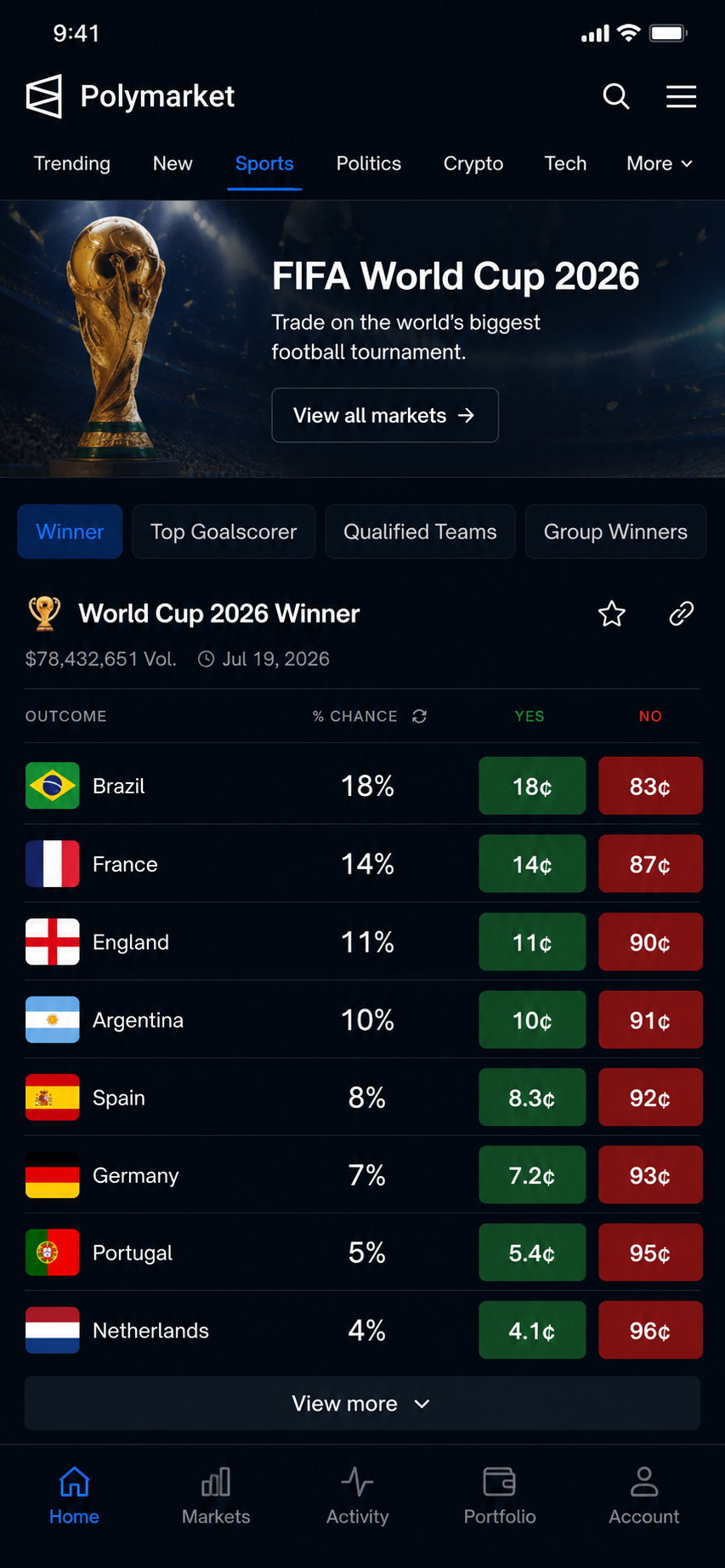
Unlike a conventional sportsbook, Polymarket operates as an exchange. Traders buy and sell shares representing possible outcomes of an event, with market prices effectively indicating the crowd's estimated probability that an outcome will occur. Markets can cover elections, economics, cryptocurrency, entertainment and sports.

That distinction—between trading a prediction contract and placing a bet—has become the central regulatory issue surrounding Polymarket in Italy.

How Polymarket Works

A typical Polymarket contract poses a question with objectively resolvable outcomes, frequently "Yes" and "No." If a Yes share trades at $0.65, the market can broadly be interpreted as assigning approximately a 65% probability to that outcome.

Traders can sell their positions before the event is resolved or hold them until settlement. Correct shares ultimately settle at $1 while losing shares settle at zero.

This market structure makes Polymarket look somewhat like a financial exchange, but regulators in a number of jurisdictions have concluded that contracts based on uncertain events can also fall within gambling laws.

The distinction becomes particularly significant when Polymarket offers markets involving football.

A market such as "Will Inter win the Serie A title?", for example, can produce an experience functionally similar to sports betting even though the price is established by buyers and sellers rather than odds generated by a bookmaker.

Italy Moves Against Polymarket

Italy has accepted the gambling interpretation of prediction market contracts.

The Agenzia delle Dogane e dei Monopoli (ADM), which regulates Italy's legal gambling industry, placed Polymarket's domain on its list of unauthorized gambling websites. In July 2026, ADM again ordered restrictions against the platform, requiring Italian internet providers to prevent access to the domain and redirect visitors to an ADM notice indicating that the operator does not possess the authorization required to collect wagers in Italy.

It was not the first confrontation.

Polymarket had previously been subjected to an Italian blocking measure in October 2025. The company challenged the action before the Lazio Regional Administrative Court, and the website subsequently became accessible again for a period, although transactions from Italy remained restricted.

By July 2026, however, Polymarket was back on ADM's blacklist.

Polymarket itself currently identifies Italy as a restricted jurisdiction for trading in its geographic-restrictions documentation.

That point is important: the growing international popularity of prediction markets should not be confused with authorization to operate them as wagering products in Italy.

Football Creates a Particularly Difficult Regulatory Question

Football could potentially be one of the largest categories for prediction markets in Italy.

Serie A, UEFA competitions, international football and the World Cup provide an enormous number of events that could theoretically support prediction contracts: match winners, tournament champions, relegation, qualification, transfers and individual-player propositions.

But football also makes the argument that prediction markets are fundamentally different from gambling harder to sustain from an Italian regulator's perspective.

A contract asking whether a political party will win an election may resemble an event derivative. A market asking whether team Juventus will defeat team Milan can closely resemble an ordinary football wager.

Italian reporting surrounding the latest Polymarket restrictions specifically noted that the regulatory confrontation was occurring as prediction markets increasingly moved into football and World Cup-related markets.

The Lazio Connection

The dispute became even more conspicuous because Polymarket established a visible connection with Italian professional football through S.S. Lazio.

Polymarket branding appeared on Lazio shirts even as the prediction-market operator faced restrictions imposed by Italy's gambling regulator. Italian coverage consequently raised questions about the unusual situation in which a prediction-market brand could obtain significant exposure through Italian football while its trading service was not authorized for Italian customers.

This illustrates a broader regulatory problem facing sports organizations: advertising a prediction-market company and legally offering its event contracts to local residents are separate questions.

Gambling or Financial Market?

The Italian controversy reflects a much larger international debate.

Prediction-market operators can argue that their platforms aggregate information through market prices. Participants trade against one another, prices fluctuate according to supply and demand, and positions can generally be sold before settlement. Those characteristics resemble exchange trading more than the traditional customer-versus-bookmaker model.

Regulators can reach a different conclusion.

From their perspective, customers are still putting money at risk on uncertain future events and receiving money when their prediction proves correct. When the underlying event is a football match, the similarity to conventional betting becomes particularly obvious.

Italian gaming-law analysis following the reguly 2026 action concluded that the regulator's position effectively means that an operator wishing to offer such products in Italy would need to address the country's gaming-concession system rather than simply characterize its products as prediction contracts.

The result is a regulatory collision between two definitions of essentially the same technology: a market for event contracts on one side, and an unregulated wagering product on the other.

Crypto Adds Another Layer

Polymarket's crypto infrastructure further distinguishes it from Italy's conventional online bookmakers.

Blockchain-based prediction markets can operate internationally, settle contracts electronically and attract customers accustomed to cryptocurrency rather than traditional sportsbook accounts.

That technological architecture, however, does not automatically remove a platform from national gambling laws. Italy's action against Polymarket demonstrates that regulators can focus on what the product allows customers to do rather than the technology used to execute the transaction.

The same problem is appearing internationally as governments determine whether event contracts are covered under gambling, commodities, securities or other financial-market rules.

Italy Could Become an Important Test Case

Italy represents an especially significant market for this debate because it combines a national football culture with a mature, regulated online betting industry.

Prediction markets could theoretically create a new category between sportsbooks and financial exchanges. Instead of accepting fixed bookmaker odds, customers could trade continuously changing probabilities against other market participants.

That model could eventually become a serious competitor to conventional sports betting.

For now, however, the regulatory position is substantially clearer than the technological distinction: Polymarket trading is restricted in Italy, and ADM has treated its offering as unauthorized gambling rather than an unrestricted financial prediction service. Polymarket's own geographic-restrictions page likewise lists Italy among the jurisdictions where trading is restricted.

The long-term question is therefore not whether Italians are interested in prediction markets. Football, politics, cryptocurrency and financial events provide an obvious potential audience.

The question is whether Italy will eventually create a regulatory framework specifically for prediction markets—or continue requiring platforms offering event-based contracts to fit within the country's existing gambling framework.

Until that issue is resolved, Italy provides a striking example of the challenge facing the prediction-market industry worldwide: technology can turn almost any future event into a tradable market, but national regulators still decide when that market becomes a bet.

Criminal ring busted for operating illegal pornography, gambling sites from overseas

Police said Wednesday they have busted a criminal ring suspected of creating and operating illegal pornography and gambling websites to earn several tens of billions of won.

The Seoul Metropolitan Police Agency said two key members of the ring, aged 40 and 36, respectively, have been arrested and referred to the prosecution on charges of distributing child sexual exploitation materials, among other offenses.

The police agency also said it was investigating about 10 accomplices, including the ring leader and manager who are believed to be working abroad.

The suspects are accused of systematically operating 18 illegal gambling websites and two pornography websites from Pasay City, Philippines, and other locations since August 2019.

They initially attracted users to their pornography sites, which distributed child and adolescent sexual exploitation materials and illegally filmed content, before upsetting potential gambling members by placing advertisements for their gambling sites on the pornography sites.

The total amount wagered on the gambling sites over approximately five years was estimated at 4.7 trillion won (US$3.32 billion), while the police estimate the suspects made about 47.6 billion won in profits from the operations.

The two illegal pornography sites hosted about 116,000 videos, had 2.85 million registered accounts and recorded a cumulative 5.35 billion views, the police said.

The 40-year-old suspect was in charge of operating the illegal sites in the Philippines, while the 36-year-old suspect, who holds a doctorate degree in computer engineering, was responsible for the sites' overall development, management, maintenance and repair. The 40-year-old was arrested while attempting to enter South Korea on Aug. 2, while the 36-year-old was arrested at his home in South Korea on Aug. 3.

Shadows of the Screen: The Dangerous Convergence of Illegal Online Gambling and Adult Content Networks in South Korea

South Korea boasts one of the most advanced digital infrastructures in the world, characterized by lightning-fast broadband and near-universal smartphone penetration. However, this hyper-connected ecosystem has also given rise to a dark underbelly: a sophisticated, rapidly expanding illicit economy fueled by illegal online gambling and unregulated adult media networks.

While South Korea maintains strict legal frameworks governing public morality and financial transactions, criminal syndicates have continually exploited technological loopholes, transnational servers, and cross-platform funnels to evade authorities.

The Landscape of Illegal Online Gambling

South Korea’s legal gambling market is heavily restricted and tightly controlled by the state. While citizens can legally purchase national lotteries, horse racing, and cycle racing tickets, casino access is almost exclusively limited to foreign nationals. The sole exception for locals is Kangwon Land, a remote mountain casino located far from the capital.

Because lawful gambling avenues for domestic citizens are minimal, an enormous grey and black market have flourished. According to data from the National Gambling Control Commission (NGCC) and criminological research institutes, the illegal online gambling market has exploded—reaping revenues multiple times larger than the legal sector.

  • The Youth Demographic at Risk: A particularly alarming trend is the infiltration of illegal gambling among minors and young adults. Studies indicate that a rising number of teenagers view online gambling sites as casual video games rather than financial risks, creating a pipeline for adolescent addiction.
  • Transnational Operations: Many illegal platforms operate servers hosted in foreign jurisdictions—such as the Philippines or other parts of Southeast Asia—while targeting South Korean users through localized Korean-language interfaces, crypto-currency transactions, and encrypted messaging apps.

The Exploitative Convergence: Adult Sites as Funnels

While illegal gambling platforms traditionally relied on spam text messages, pop-up ads, or social media promotions to attract users, recent law enforcement investigations have exposed a far more sinister convergence: the direct operation of illicit adult content websites to capture and funnel captive audiences.

Organized crime rings have increasingly bypassed third-party advertising, choosing instead to directly build and manage extensive networks of illegal pornography platforms—including sites distributing severe non-consensual and child sexual exploitation material.

Recent major crackdowns by the Seoul Metropolitan Police Agency illustrate the gravity of this trend. Transnational syndicates have operated massive infrastructure combining thousands of explicit video clips, millions of registered accounts, and billions of views. These sites serve as high-traffic funnels, subtly or aggressively redirecting visitors straight to integrated online betting portals. Through this synergetic criminal model, operators generate dual streams of illicit revenue: advertising/membership fees from adult media and high-stakes wagers from hooked gamblers.

Regulatory Responses and Ongoing Challenges

South Korean authorities, including the Korea Communications Standards Commission (KCSC) and specialized cybercrime units, continuously block illicit web domains, deploy big-data monitoring systems, and dismantle domestic payment-laundering channels.

However, combating these digital networks presents persistent challenges:

  1. Whack-a-Mole Phenomenon: When authorities block a domain, operators instantly deploy mirror sites, altering URLs and utilizing shifting proxy servers to restore operations within hours.
  2. Cross-Border Complexities: Because key masterminds often base their core technical operations overseas, investigations require complex international police cooperation, including Interpol Red Notices and coordination with foreign law enforcement.
  3. Technological Evasion: The growing adoption of advanced anonymization tools, virtual accounts, and decentralized methods makes tracking illicit cash flows increasingly difficult.

Conclusion

The intersection of illegal online gambling and predatory adult networks represents a multi-faceted crisis for South Korea—blending financial crime, severe digital sex offenses, and public health concerns regarding addiction. As syndicates leverage increasingly sophisticated technology to target vulnerable demographics, authorities face an ongoing technological challenge to fortify digital boundaries and protect the public from hidden online harms.

Court rules casino operator not liable for VIP deposits not used for gambling

VIP casino concessionaire in Macau

The top court in Macau has ruled that a casino concessionaire is not jointly liable for funds deposited with a gaming promoter even though the money was not intended for gambling.

The Court of Final Appeal (TUI) dismissed an appeal by an account holder, who sought to recover HKD43.82 million, including interest, from a casino concessionaire.

The case involved a gaming promoter operating a VIP room at the concessionaire's casino, as well as the promoter's shareholder and administrator.

According to a statement from the court, the promoter's shareholder and administrator offered the guest free transportation, hotel accommodation, and meals, and promised monthly interest of 1.2% to encourage him to deposit money with the VIP room. Between September 2014 and April 2015, the man deposited HKD30 million (USD 3.82 million) in three installments of HKD10 million (USD 1.275 million).

The court found that the deposits were made solely to earn interest and receive the promised services, rather than for gambling.

The funds ceased accruing interest in October 2015 and the client was denied access to his VIP account in 2016. He later asked the casino concessionaire to return HKD37.2 million (USD 4.74 million) but received no response. He filed a lawsuit in 2020 seeking HKD43.82 million (USD 5.59 million), including interest.

The Court of First Instance rejected the claim, a decision later upheld by the Court of Second Instance. The man then appealed to the TUI.

The TUI ruled that casino concessionaires can be held jointly liable for certain activities conducted in their casinos. However, under the interpretive provision in Article 63 of Law No. 16/2022, which applies retroactively to pending cases, the court must determine whether funds or chips accepted by gaming promoters were used for casino gambling or won through gambling.

In this case, the court found that the deposits were intended to generate interest rather than facilitate gambling. They therefore did not fall within the activities covered by Article 63 and could not trigger the concessionaire's joint liability under Article 29 of Administrative Regulation No. 6/2002.

The court also rejected the man's argument that the concessionaire was liable under the rules governing apparent commercial representation, finding no evidence that the casino operator had acted in any way that could have created such reliance. The court noted that the client had no contact with the concessionaire, and that the deposits were made at the promoter's suggestion.

The TUI therefore dismissed the appeal and upheld the lower courts' decisions.

VIP Accounts, Money Laundering and Tax Evasion in Macau's Casino Industry

Cyberpunk Social Casino illustration

For decades, Macau's VIP casino sector occupied an unusual position at the nexus of legal gambling, private credit, cross-border capital flows, and an extensive network of gaming promoters commonly known as junkets. The system helped transform Macau into the world's largest casino market, but it also created opportunities for criminals, corrupt officials, and wealthy gamblers seeking to move money outside conventional banking channels.

The Financial Action Task Force (FATF) and Asia/Pacific Group on Money Laundering (APG) have specifically identified casinos, junkets, and VIP programs as areas vulnerable to money laundering. Their research describes how junket operators can maintain agents in multiple jurisdictions and use both formal and informal remittance networks to transfer customers' funds.

How the VIP System Worked

Macau junkets traditionally recruited wealthy gamblers, particularly customers from mainland China, and hosted them in private VIP gaming rooms operated in association with licensed casinos.

The arrangement provided much more than luxury accommodation and private baccarat tables. Junkets could extend gambling credit, maintain customer accounts, settle gambling debts, and arrange transfers between jurisdictions.

This was particularly valuable to gamblers facing restrictions on moving large amounts of currency out of mainland China.

Instead of simply arriving in Macau carrying millions of dollars in cash, a VIP customer could establish a financial relationship with a junket or its agents. Money could be delivered or transferred in one jurisdiction while corresponding gambling credit was made available in Macau ("Flying Money").

The FATF/APG documented a Macau case in which a casino agent received substantial cash from a mainland customer. The money was divided into smaller amounts near Zhuhai and transported into Macau, where it was ultimately consolidated and converted into a cashier's order for a casino VIP room. Gambling winnings could subsequently be remitted back through underground banking channels.

This illustrates why VIP accounts were potentially valuable for more than gambling. They could function as part of an underground financial network, operating alongside the regulated banking system.

Turning Money Into Casino Chips

Casino chips provide an additional layer between the original source of funds and the money ultimately withdrawn by a gambler.

A customer entering a VIP room might receive chips against money or credit previously deposited with a junket. After gambling, the remaining chips or winnings could be redeemed and the customer's account settled.

For a legitimate gambler, this is simply part of casino operations.

For a money launderer, however, casino transactions can potentially obscure the financial trail between the original funds and the money eventually received.

FATF has consequently identified casinos as particularly vulnerable because of their combination of large financial transactions, cash-intensive operations, and international customers. It has also specifically identified weaknesses involving junkets and VIP programs as a money-laundering risk.

VIP Rooms and Underground Remittance

The junket system also created an important connection between gambling and underground banking.

FATF/APG documented another Macau typology involving a merchant who was unable to make a large international remittance because of foreign-exchange controls. With assistance from a junket promoter and casino VIP room, money could instead be transferred through the gambling system.

The significance of such arrangements extends beyond casino gambling. A junket with customers, agents, and financial relationships in Macau, mainland China, and other Asian jurisdictions could effectively provide an alternative settlement network.

Money did not necessarily have to physically travel along the same route as the customer.

Funds received by one agent could potentially be balanced against funds held elsewhere within the network.

Under-the-Table Betting and Tax Evasion

Another major vulnerability involved so-called parallel betting, sometimes called multiplier or under-the-table betting.

The principle was relatively simple: the wager officially recorded at the casino table could represent only part of the economic bet being made between the gambler and another party.

A wager recorded by the licensed casino therefore might not reflect the complete financial exposure associated with the game.

This distinction is significant because Macau's gaming taxes are calculated from casino gaming revenue. Gambling occurring outside the officially recorded casino accounting system can consequently evade government gaming-tax revenue collection.

The scale of the problem became particularly visible during the prosecution of former Suncity junket boss, Alvin Chau.

Prosecutors accused Chau and associates of operating illegal parallel-betting activities associated with VIP gambling. Chau acknowledged during his trial that parallel betting had been commonplace in Macau VIP rooms, although he disputed allegations concerning his personal responsibility for illegal operations.

The court ultimately sentenced Chau to 18 years imprisonment for offenses including operating illegal gambling and leading a criminal organization. He was acquitted of the money-laundering charge. Authorities estimated that illegal side-betting activities deprived the Macau government of approximately HKD 8.26 billion — roughly USD 1 billion — in gaming-tax revenue between 2013 and 2021.

The distinction is important: allegations or convictions involving illegal gambling and tax losses should not automatically be described as convictions for money laundering.

VIP Accounts as Shadow Financial Infrastructure

The fundamental vulnerability of the old junket system was therefore not simply the existence of high-stakes gambling.

It was the combination of several services under the control of intermediaries:

  • customer accounts and gambling credit;
  • premium-value casino chips;
  • private VIP rooms;
  • cross-border agents;
  • debt settlement;
  • informal remittance networks; and
  • financial relationships extending beyond the casino itself.

Together, these services could create something resembling a private financial infrastructure operating around the regulated casino.

The FATF/APG has warned that junkets' use of agents and alternative remittance systems can complicate suspicious-transaction reporting and make it harder for regulators to determine the ultimate source and destination of funds.

Macau's Crackdown on the Junket Model

The arrest and prosecution of major junket executives marked a turning point.

Macau subsequently tightened its gaming regulatory framework, while China's broader campaign against cross-border gambling and illicit capital movements placed additional pressure on the traditional VIP model.

Academic analysis published in 2026 describes Macau's reforms between 2022 and 2024 as effectively dismantling much of the traditional junket ecosystem. The reforms aligned Macau's casino regulation more closely with mainland China's objectives concerning financial transparency, capital controls, and anti-money-laundering enforcement.

The economic consequences have been substantial.

Macau has increasingly shifted toward premium-mass and ordinary mass-market gamblers rather than relying on the high value turnover historically generated through junket-controlled VIP rooms.

From Casino VIP Room to Financial Crime Risk

VIP gambling itself is neither money laundering nor tax evasion. Wealthy customers can legitimately maintain casino accounts, obtain credit, and wager large amounts of money.

The regulatory problem emerges when private gambling accounts are combined with opaque beneficial ownership, third-party deposits, underground remittance, unrecorded wagers, or transactions whose economic purpose extends beyond gambling.

In those circumstances, a VIP account can potentially become more than a gambling facility. It can become one component of a cross-border financial network.

Macau's experience demonstrates why regulators increasingly examine not only what occurs on the baccarat table, but also who supplied the money, who controls the account, how gambling credit was created, whether the full wager was recorded, and where the money ultimately went.

The decline of Macau's traditional junket industry therefore represents more than a change in casino marketing.

It reflects an attempt to close the gap between the regulated gaming economy and the shadow financial networks that historically developed around some segments of the VIP business.

Kalshi and Polymarket bets on clinical trials criticized as 'ghastly'

Kalshi Clinical Trials Prediction Markets

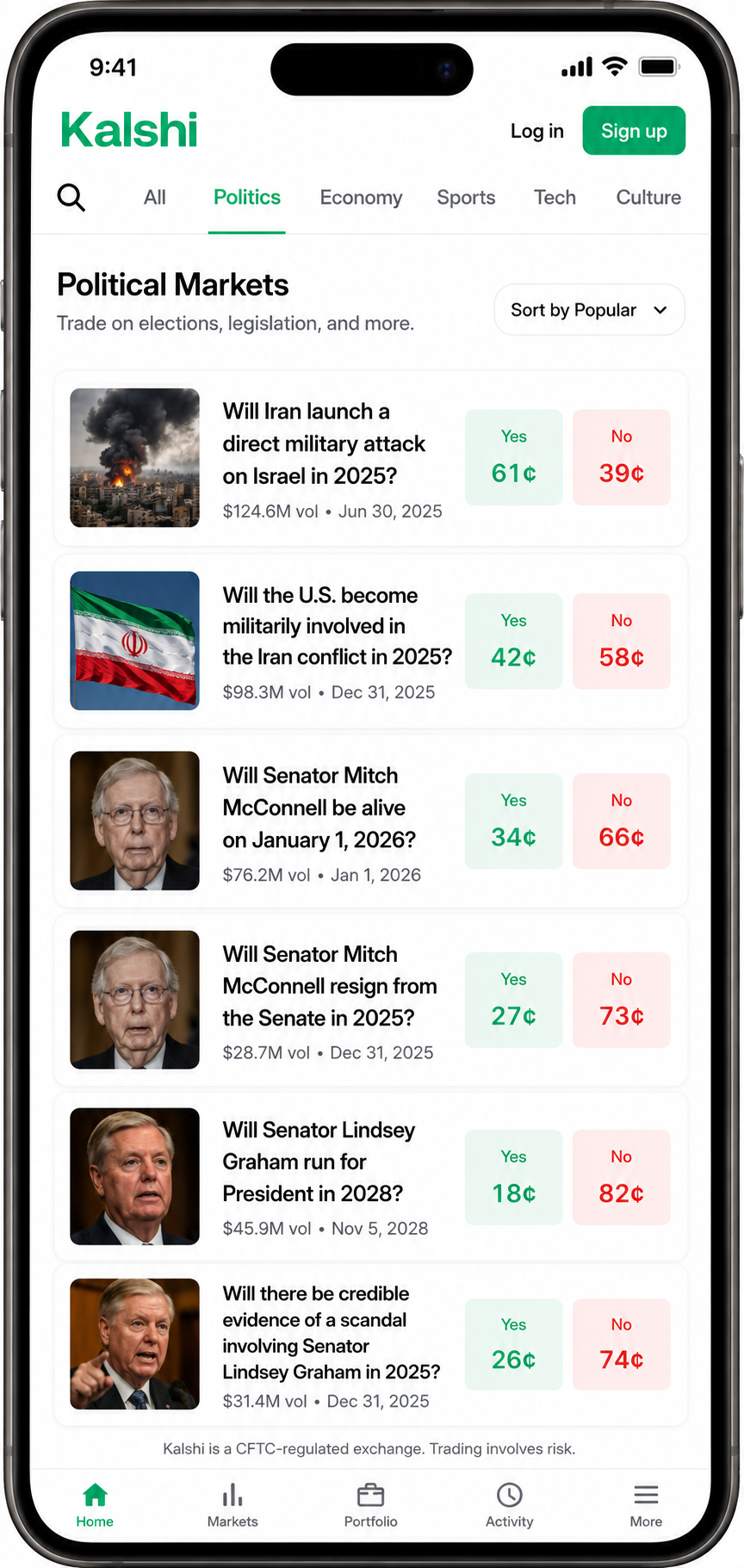
In addition to billions in markets for elections and conflicts in the Middle East, Polymarket and Kalshi are being criticized for accepting unethical bets on clinical drug trials.

Clinical trials are just the latest area where the industry's rapid growth is raising ethical questions.

Kalshi counters that such bets will provide a new source of market sentiment about which drugs will get approved, and what clinical trials will show promising results, which the company says can help investors decide what new drug companies to fund.

"If you want to ban profiting from the failure of clinical trials, you would start with the stock market, where the financial incentive for this type of profit is orders of magnitude larger,"
— Jack Such, Kalshi Spokesman

Mr. Such pointed to stock market short sellers who have profited from clinical trial failures, noting, "While Kalshi and the stock market are the same in this regard, they do differ in one important way: the stock market doesn't give any valuable information to researchers."

David Tsai, who heads clinical trials at a biotech company in the San Francisco Bay Area, launched an online petition pushing for a ban on such betting, making the case that betting on drug trials "threatens the very foundation of trust and integrity in biotechnology."

Tsai is concerned that the prospect of betting creates a risk of those directly involved with a clinical trial having an incentive to corrupt the results for a prediction market gain.

"If we were running a trial for an oncology drug that requires an infusion, a pharmacist who had placed a bet saying that it's gonna work well, or doesn't work well, could obviously adjust the infusion rate, could adjust the source temperature of the drug. They could change any number of variables that could obviously have a direct impact [on] how the trial and the data and the patient safety would come out."
— David Tsai, Biotech Clinical Trials Head

Another skeptic, Nicholas Zaorsky, a professor of radiation oncology at the Mayo Clinic in Jacksonville, Fla., who has helped run clinical trials, agrees that prediction markets can interfere with the advancement of life-saving drugs.

"Prediction markets can be valuable in some settings because they aggregate information, but clinical trials are fundamentally different: investigators, coordinators, and sometimes even participants can directly influence aspects of the outcomes being wagered on. That creates financial incentives that risk undermining trials."
— Nicholas Zaorsky, Mayo Clinic

Clinical-Trial Prediction Markets Emerge as a New Frontier for Kalshi and Polymarket

Prediction markets are metastasizing into one of their most controversial—and potentially valuable—new markets: pharmaceutical clinical trials and drug approvals.

Kalshi and Polymarket, two of the world's largest prediction-market platforms, now offer contracts allowing traders to speculate on pharmaceutical and regulatory events, including whether experimental drugs will succeed in clinical trials and whether the U.S. Food and Drug Administration (FDA) will approve particular treatments.

Although the clinical-trial segment remains a niche compared with the billions traded on elections and sports, early trading suggests that biotechnology could develop into a significant specialist prediction-market category.

Kalshi Launches Clinical-Trial Markets

Kalshi made its biggest move into the sector on July 16, 2026, announcing a partnership with pharmaceutical intelligence company AppliedXL to introduce a pilot group of prediction markets covering clinical-trial results and FDA regulatory decisions.

The initial program focuses on late-stage Phase 3 trials conducted by established biotechnology and pharmaceutical companies, as well as FDA full-approval decisions.

Example contracts include whether the Phase 3 POLARIS-AD trial of AR1001 will meet its primary endpoint in early Alzheimer's disease and whether the FDA will approve anito-cel, a multiple-myeloma treatment developed by Arcellx and Gilead Sciences.

The contracts transform complex scientific questions into binary markets. A contract trading at 70 cents, for example, can broadly be interpreted as the market assigning approximately a 70% probability to the event occurring.

With trading starting from a relatively small base, Forbes reported that more than $100,000 had already been wagered across Kalshi's new pharmaceutical markets on their first day, covering more than a dozen pharmaceutical outcomes.

That figure should not be mistaken for the total size of Kalshi's clinical-trial business. The product is new, contracts have different expiration dates, and reported pharmaceutical figures can combine clinical-trial and FDA-approval markets. There is not yet a reliable public figure separating lifetime clinical-trial trading volume from the broader pharmaceutical category.

The potential scale of the platform supporting those markets, however, is enormous. Kalshi recorded approximately $27 billion in trading volume during the 2026 FIFA World Cup alone, according to Reuters. Clinical trials therefore represent a very small niche within an exchange already capable of processing billions of dollars of event-contract trading.

Polymarket Builds a Pharmaceutical Market

Polymarket has also developed an increasingly substantial collection of markets connected to pharmaceuticals, biotechnology, disease, and FDA decisions.

Its FDA prediction section currently reports more than $4.5 million in aggregate trading volume associated with FDA-tagged markets.

However, this number requires caution. Polymarket's FDA category is broader than clinical trials, and its automated categorization includes contracts that are not directly related to pharmaceutical research. It therefore cannot be treated as $4.5 million of pure clinical-trial wagering.

Individual pharmaceutical markets demonstrate that meaningful liquidity can nevertheless develop around particular drugs.

One of the largest current examples concerns Eli Lilly's experimental obesity treatment retatrutide. Polymarket reports roughly $578,000 in trading volume on a contract predicting whether the FDA will approve retatrutide during 2026.

Other pharmaceutical contracts have generated smaller but still significant amounts. A previous Polymarket contract concerning FDA approval of the gene therapy UX111 generated approximately $41,400 in trading volume.

This suggests that, at least for now, pharmaceutical prediction-market liquidity is highly concentrated. Drugs attracting high-profile investor, patient, and media interest can generate hundreds of thousands of dollars in trades, while obscure treatments may attract only a few thousand dollars.

A Small Market Inside a Massive Industry

The underlying pharmaceutical industry is vastly larger than the prediction markets developing around it.

Kalshi says the average cost of bringing a drug to market has been estimated at approximately $2.3 billion. A successful Phase 3 trial or FDA decision can add billions of dollars to the market capitalization of a publicly listed pharmaceutical company, while a failed trial can destroy much of the value of a smaller biotechnology company almost immediately.

This creates an unusual environment for prediction markets.

Traditional investors seeking exposure to a clinical trial normally purchase shares or options in the pharmaceutical company. But the company's share price reflects much more than one experiment: revenue, management, other drugs in development, financing conditions, and the broader stock market are all incorporated into its valuation.

A prediction contract can focus strictly on the scientific event.

Instead of asking whether a biotech company's stock will rise, a trader can take a position on a specific question such as:

Will the Phase 3 clinical trial meet its primary endpoint?

That difference could eventually make clinical-trial prediction markets useful to biotechnology investors as a specialized information and hedging instrument.

Kalshi vs. Polymarket

At present, the available numbers suggest that Polymarket has accumulated more visible trading volume around FDA-related pharmaceutical events, while Kalshi has established a more formal framework specifically designed for clinical-trial outcomes.

Polymarket reports more than $4.5 million across its broad FDA-tagged category, with some individual drug markets exceeding half a million dollars. Kalshi's dedicated biotech initiative began only in July 2026 and exceeded $100,000 across its pharmaceutical contracts on launch day.

These figures are not directly comparable. The Polymarket number includes a much broader and established collection of FDA-tagged markets, while the Kalshi figure represents early activity around a newly launched group of pharmaceutical contracts.

The entire prediction-market industry is also expanding at an extraordinary rate. Recent reports put Kalshi's overall contract volume at approximately $41 billion, compared with about $13 billion for Polymarket over the cited period. Polymarket, meanwhile, has reportedly entered fundraising discussions at a valuation exceeding $20 billion, while Kalshi has reportedly reached a valuation of approximately $22 billion.

Against those figures, today's clinical-trial market is still a niche.

But that is precisely what makes the category significant: even capturing a fraction of the trading interest surrounding biotechnology stocks, FDA decisions, and major pharmaceutical launches could turn it into a growing market measured in tens or eventually hundreds of millions of dollars.

The Information Value of a Bet

Kalshi argues that the purpose of these markets extends beyond speculation.

Clinical-development probabilities are extremely valuable to pharmaceutical companies, hedge funds, investment banks, and venture-capital firms. Much of that forecasting traditionally remains inside proprietary research departments and expert networks.

A liquid public prediction market potentially creates a continuously updated probability available to everyone.

As new trial information, scientific publications, or regulatory developments become public, traders buy and sell contracts. The resulting market price becomes a real-time estimate of the probability of success.

Whether those probabilities prove more accurate than pharmaceutical analysts remains an open question. Research into prediction markets shows that market prices should not automatically be treated as perfectly calibrated probabilities, particularly when trading volume and liquidity are low.

Clinical trials may present an especially difficult test case because the field requires the skills of sophisticated investors with specialized industry knowledge of statistics, medicine, trial design, and FDA regulation.

Insider Information Risk

Clinical-trial markets also create an obvious regulatory problem: some people already know—or may have access to—the results before they become public.

Researchers, pharmaceutical employees, contract research organizations, statisticians, and other participants can potentially possess material non-public information concerning a trial.

Kalshi's pilot therefore includes safeguards intended to reduce this risk. The platform says clinical-trial contracts are restricted to late-stage studies and are not opened until patient enrollment has closed. Traders must also verify that they are not trading on material non-public information.

Resolution is designed around public records. AppliedXL provides infrastructure for determining outcomes using predetermined sources such as ClinicalTrials.gov primary endpoints, FDA approval letters, and FDA advisory-committee records.

Nevertheless, the combination of potentially lucrative financial gains and a relatively small prediction market means insider trading and market manipulation are likely to be significant risks.

Market Forecast

While there is insufficient trading history to produce a credible estimate of the eventual size of the clinical-trial prediction-market industry, the available evidence instead describes an early-stage market measured in millions rather than billions of dollars.

Polymarket's broad FDA category has surpassed $4.5 million in reported trading volume, while individual high-profile pharmaceutical contracts can reach hundreds of thousands of dollars. Kalshi's newly introduced pharmaceutical markets surpassed $100,000 almost immediately after launch.

The larger platforms supporting those contracts, however, already process tens of billions of dollars.

If pharmaceutical prediction markets follow the development pattern seen in political and sports contracts—more markets producing greater liquidity, which attracts more sophisticated traders and generates still greater liquidity—the category could expand rapidly.

Clinical trials possess many characteristics prediction markets need: binary outcomes, major economic consequences, scheduled announcements, intense disagreement among analysts, and authoritative sources capable of determining the final result.

The unresolved question is whether enough traders are willing to risk funds behind those predictions.

In 2026, clinical-trial prediction markets remain an experiment themselves. But Kalshi and Polymarket have begun turning one of biotechnology's most closely guarded numbers—the probability that an experimental drug will actually succeed—into a publicly traded price.

Nara Court Hands 4 Suspended Terms Over Illegal Remote Pachinko Gambling Ring

Tokyo, Japan. Staff Reporter. Source: The Tokyo Reporter
Underground Pachinko Parlor

The Nara District Court has handed suspended prison sentences to four individuals, including three Chinese nationals, for their roles in operating an illegal remote pachinko gambling ring out of a local warehouse, according to the Sankei Shimbun (Aug. 4).

The court and investigative sources reported that the sophisticated operation was run from a warehouse in Yamatokoriyama City. Inside, over 100 retail pachinko and pachislot machines were installed, each equipped with internet-connected webcams.

Targeting Chinese gamblers, the ring utilized a native smartphone app. Players would deposit money via bank transfer, which was then converted into in-app points, allowing them to remotely control the machines and gamble in real-time. Over a 15-month period, the operators generated profits by collecting a cut of the wagers as a commission, though the exact amount of their illicit earnings was not disclosed.

Between May and July, the court handed down sentences of 14 months in prison, suspended for three years, to three of the defendants: a 68-year-old Japanese former company executive who advised the ring on the gaming machines, a 32-year-old Chinese female graduate student, and a 27-year-old Chinese man who worked part-time at the warehouse.

The fourth defendant, a 32-year-old Chinese woman who quit her job at the warehouse after discovering the Nara Prefectural Police investigation, was handed an identical suspended sentence.

During the trial, it emerged that the four accomplices had been coerced by the ring’s boss — believed to be a Chinese businessman — who took advantage of their financial struggles and goodwill. However, the principal operator remains at large, an outcome authorities say highlights the limitations of international criminal investigations.

Japan's Underground Pachinko Economy: One of the World's Largest Gray Markets

Cyberpunk Social Casino
Tokyo 2088 Pachinko

For decades, Japan's pachinko industry has occupied a unique position between legal entertainment and underground gambling. Although casino-style gambling is generally prohibited under Japanese law, pachinko parlors operate through a long-established legal loophole that allows players to exchange winnings for prizes, which are then redeemed for cash at separate off-site exchange booths. This "three-party exchange system" has enabled pachinko to become one of the world's largest gambling-related industries while remaining outside the legal framework of conventional casino regulation.

Market Size

At its peak during the mid-1990s, Japan's pachinko industry generated an estimated ¥30.9 trillion (approximately US$210 billion) in annual handle, making it one of the largest gambling markets in the world. While the industry has contracted significantly because of demographic changes (i.e., a shrinking player population), tighter regulation, and competition from online entertainment, it remains highly lucrative.

Recent industry data indicates:

  • Annual pachinko handle: approximately ¥14.6 trillion (US$95–100 billion).
  • Industry gross profit: around ¥2.38 trillion (US$15 billion).
  • Employment: roughly 500,000 people across parlors, machine manufacturers, distributors, and suppliers.
  • Thousands of pachinko and pachislot parlors continue to operate nationwide.

Even after years of decline, Japan's pachinko market remains substantially larger than the legal casino industries of many countries.

The Gray Market Cash System

Japanese law prohibits gambling establishments from directly paying cash prizes. Pachinko operators instead use a system involving three legally separate businesses:

  • Players exchange steel balls or medals for "special prizes."
  • The prizes are sold to an independent exchange booth located off premises.
  • The exchange operator resells the prizes through wholesalers back into the pachinko distribution system.

This arrangement allows cash to circulate without the parlor itself paying winnings directly, placing pachinko in a long-recognized legal gray area.

Links to Organized Crime

Historically, Japanese organized crime groups, including elements of the Yakuza, maintained influence over portions of the pachinko industry through machine distribution, lending, protection rackets, and prize exchange operations.

Beginning in the 1990s, Japanese authorities introduced stronger regulation, electronic accounting systems, anti-money laundering measures, and organized crime exclusion ordinances that substantially reduced direct criminal involvement. While isolated criminal cases still occur, the industry's oversight is considerably stronger than in previous decades.

Economic Importance

Despite declining participation, pachinko remains a significant contributor to Japan's consumer economy. The industry supports:

  • Commercial real estate.
  • Manufacturing of gaming machines.
  • Electronic component suppliers.
  • Logistics and maintenance companies.
  • Advertising and media businesses.
  • Food, beverage, and retail services located around pachinko parlors.

The industry's turnover still exceeds that of many major retail sectors, highlighting its continuing economic significance.

Future Outlook

Japan's pachinko market is expected to continue shrinking gradually as its traditional customer base ages and younger consumers increasingly prefer mobile gaming, e-sports, and online entertainment. At the same time, the drive to open regulated integrated casino resorts is likely to reshape Japan's gambling landscape over the coming decade.

Nevertheless, with an estimated annual handle approaching ¥15 trillion (approximately US$100 billion), pachinko remains one of the largest gambling-related markets in the world and one of the most distinctive examples of a long-standing gray-market gaming system.

3 Chinese Nationals Among 4 Held Over Online Gambling, Fraud Ring in Dhaka's Bashundhara: DMP

Dhaka gambling den scene
Dhaka Gambling Den.

Dhaka, Bangladesh. 2 August 2026. Press Release. Source: The Daily Star

The Detective Branch (DB) of Dhaka Metropolitan Police announced the arrest of four suspects, including three Chinese nationals, from the capital's Bashundhara Residential Area for allegedly operating an online gambling and fraud ring.

The arrestees were identified as Jhorna Chakma Jiana, 27; Liu Hui Zhang, 46; Wei Yuji, 30; and Xie Yi Ran, 42.

Acting on an informant's tip, a team from the DB's Cyber Crime Division raided a six-storey building in Bashundhara Residential Area on Saturday night and arrested the four, according to a press release issued by the DMP media wing.

During the operation, the team seized 14 laptops, 16 smartphones, more than 6,000 active SIM cards from various mobile operators, and 20 gateway devices. Officers also recovered 26 bottles of foreign liquor and Tk 209,700, approximately USD $1,700, in cash from the scene.

In addition to the illegal gambling-related contraband, possession of alcohol in Bangladesh is strictly controlled by the Narcotics Control Act and the Alcohol Control Rules. Official government permits may be required based on religion, age, and medical status. Any drink containing more than 0.5% alcohol is subject to these strict laws.

According to the press release, Jhorna rented all the flats in the building and sublet the fourth and fifth floors to the Chinese nationals, who allegedly operated an illegal VoIP front business and an online gambling network using advanced digital technology.

The ring allegedly targeted victims by sending promotional text messages containing links that promised job opportunities or extra income. Once recipients clicked the links, they were drawn into fraudulent schemes.

To evade surveillance, the suspects allegedly used technology that enabled a single mobile phone to operate 12 SIM cards simultaneously through multiple external SIM slots.

As a result, even when victims filed complaints after losing money, it was difficult to immediately identify the device involved because of the multiple SIM cards, Dhaka detectives said.

Illegal Gambling in Bangladesh: A Growing Underground Digital Economy
Cyberpunk social casino scene inspired by Dhaka, Bangladesh
Cyberpunk Social Casino.

Although nearly all forms of gambling are prohibited under Bangladeshi law, illegal betting continues to flourish through underground gambling dens, online sportsbooks, offshore casino websites, and organized criminal networks.

The widespread use of smartphones, social media, and digital payment systems has enabled gambling operators to reach millions of potential customers despite aggressive law enforcement efforts.

Strict Gambling Laws

Bangladesh prohibits most gambling under the Public Gambling Act of 1867, along with other criminal statutes used to prosecute illegal gambling, money laundering, and organized crime.

Authorities regularly conduct raids against gambling dens, seize betting equipment, and arrest operators involved in illegal gaming activities.

Only a limited number of government-authorized activities, such as regulated state lotteries, are permitted. Casinos and commercial gambling establishments remain illegal.

The Rise of Online Gambling

While traditional gambling houses continue to operate underground, the fastest-growing sector is online gambling. Bangladeshi players increasingly access offshore betting websites offering:

  • Football and cricket betting.
  • Online slot machines.
  • Live-dealer baccarat, roulette, and blackjack.
  • Poker.
  • Lottery betting.
  • Virtual sports.
  • Mobile casino applications.

Many websites are hosted in overseas jurisdictions, complicating domestic enforcement.

Organized Crime Networks

Law enforcement agencies have uncovered gambling syndicates operating from apartments, offices, and commercial buildings.

These organizations often employ teams responsible for customer recruitment, payment processing, technical support, and money laundering.

Operators commonly advertise through social media, encrypted messaging applications, and affiliate marketing networks while using mirror websites to replace domains blocked by authorities.

Payment Methods

Illegal gambling operators increasingly rely on:

  • Mobile financial services.
  • Bank transfers.
  • Cryptocurrency.
  • Digital wallets.
  • Cash agents.
  • Informal money-transfer networks.

These payment channels can make financial investigations more complex and allow operators to move gambling proceeds across borders.

Popular Illegal Gambling Activities

The most common forms of illegal gambling include:

  • Cricket betting.
  • International football betting.
  • Online casino games.
  • Card games.
  • Cockfighting and animal betting in rural areas.
  • Underground gambling clubs.
  • Number and lottery betting.

Major sporting events such as the FIFA World Cup, ICC Cricket World Cup, Indian Premier League (IPL), and Asia Cup frequently generate surges in illegal betting activity.

Law Enforcement Response

Bangladesh Police and other enforcement agencies regularly conduct raids targeting gambling dens, betting syndicates, and financial facilitators.

Authorities have seized computers, servers, betting records, cash, mobile phones, and SIM cards used to operate illegal betting businesses.

Investigations increasingly focus on organized criminal groups that combine illegal gambling with cybercrime, fraud, and money laundering.

Continuing Challenges

Despite frequent enforcement operations, illegal gambling remains resilient. Offshore websites can quickly change domain names, relocate servers, or adopt encrypted communications to evade detection.

The popularity of smartphones and digital payments has also lowered barriers for new customers.

Experts believe that future enforcement will increasingly emphasize financial intelligence, cybercrime investigations, cross-border cooperation, and the disruption of criminal organizations rather than relying solely on website blocking.

Outlook

Bangladesh's illegal gambling market continues to evolve as technology enables operators to reach customers more easily than ever before.

While authorities have intensified enforcement against gambling syndicates and their financial networks, organized criminal groups continue to adapt rapidly.

The long-term effectiveness of enforcement is likely to depend on stronger transnational cooperation, digital investigations, anti-money-laundering measures, and continued efforts to dismantle the infrastructure supporting illegal online gambling.

35 Arrested in Ho Chi Minh City for Running $19 Million Gambling Site

Ho Chi Minh City, Vietnam. 1 August 2026. Source: Vietnam News

Police in Ho Chi Minh City have arrested and prosecuted 35 suspects involved in organizing and promoting online gambling, with the total betting handle worth more than VNĐ500 billion (US$19 million).

According to initial investigation results, since April this year, the suspects have operated the bong88.com website to offer betting on matches in the 2026 FIFA World Cup and international soccer tournaments.

bong88.com sportsbook website

bong88.com

They used a system that converted points on the website into Vietnamese đồng at a rate of VNĐ10,000 to VNĐ50,000 per point, based on agreement.

Payment for winnings or losses was transferred weekly on Mondays through bank transfers, direct cash payments, and other methods.

The investigation determined that the suspects operated under a criminal network model comprising the levels Super – Master – Agent – Member.

The suspect who held the Super role managed the overall points limit and ran the operations of up to four Master accounts held by Lê Thanh Hiếu, Nguyễn Văn Thơm, Nguyễn Tấn Đức, and Huỳnh Minh Toàn.

The Masters directly managed and allocated points limits to the Agents, monitored betting activity, and tallied winning and losing results and payments.

Four Agents were identified as Nguyễn Đình Công, Huỳnh Văn Thành, Vương Trùng Dương, and Nguyễn Trí Thông. They, in turn, issued Member accounts for bettors to place wagers through the system.

Police are continuing to expand the investigation and are searching for the suspect holding the Super role, as well as other supporting individuals.

Vietnamese Betting

Cyberpunk Social Casino in Ho Chi Minh City

Cyberpunk Social Casino

The regulated betting and gambling market in Vietnam operates under a tightly controlled framework. While traditional local gambling was heavily restricted or outright illegal for centuries, the Vietnamese government has gradually introduced legislative measures to permit limited forms of betting, horse racing, and casino gaming.

1. Legal and Regulatory Framework

The core legal structure governing legal betting and gaming is primarily defined by two major government decrees:

  • Decree 03/2017/ND-CP: Regulates the establishment, operation, and management of land-based casinos.
  • Decree 06/2017/ND-CP: Establishes the legal framework for sports betting, specifically authorizing international football matches, horse racing, and greyhound racing.

Despite these decrees creating a formal legal framework, the state maintains rigorous oversight, high entry barriers for operators, and strict parameters for participants.

2. Key Sectors of the Regulated Market
Land-Based Casinos
  • Historically, Vietnam's casinos were restricted exclusively to foreign passport holders.
  • The government later introduced a pilot program allowing local Vietnamese citizens to enter selected integrated resorts, including Corona Resort & Casino on Phu Quoc Island, with later expansion to projects such as The Grand Ho Tram and Van Don Integrated Resort.
  • To qualify, local players must be at least 21 years old, demonstrate a minimum monthly income (historically about VNĐ10 million), and pay daily or monthly entry fees.
Sports Betting and Racing
  • Decree 06 authorizes betting on approved international football matches, horse racing, and greyhound racing.
  • Legal sports betting currently requires physical retail betting locations because online and mobile sports betting are not authorized under Vietnam's existing regulatory framework.
  • Legal wagers are limited by law to a minimum stake of VNĐ1,000 and a maximum of VNĐ1,000,000 per player per day.
State Lotteries
  • Traditional and computerized lotteries operated by state-owned companies remain Vietnam's oldest, most widespread, and fully legal form of gambling.
3. Market Dynamics and the "Grey Area" Online Sector
The Domestic Bottleneck

Industry observers note that minimum capital requirements exceeding VNĐ1 trillion, daily betting limits, and the prohibition on domestic online sportsbooks have significantly constrained the growth of Vietnam's regulated betting market.

Offshore Platforms

Because domestic legal options do not satisfy consumer demand for online wagering, a multibillion-dollar underground market has developed. Vietnamese bettors frequently access offshore-licensed sportsbooks and online casinos.

While authorities aggressively prosecute illegal operators within Vietnam, individual users accessing offshore gambling websites generally exist within a widely tolerated—although technically unauthorized—grey area.

4. Future Outlook

Policymakers and industry analysts continue to debate expanding casino access for Vietnamese citizens, modernizing betting regulations, reducing capital barriers, and introducing regulated digital betting frameworks to recapture gaming revenue currently flowing to offshore operators.

14 Cotai Macau Security Staff Busted in Extortion & Protection Racket

Macau. 30 July 2026. Press Release. Source: GGRASIA.com

Macau Judiciary Police

Macau's Judiciary Police

Macau's Judiciary Police announced 14 arrests involving alleged criminal activity led by security personnel from a Cotai casino, said to have profited from banning casino rules violators from the property and subsequently offering not to report them to the police if the same guests paid extortion fees.

The security staffers at the Cotai casino—who were not named in a police media briefing as reported by local Chinese-language media outlets—were allegedly assisted by a number of intermediaries.

The extortion scheme, operating since March 2025, involved a security manager and several security guards working with intermediaries. Police allege the group collected at least HKD1.4 million (USD$165,716) in illegal "protection fees" from at least 30 individuals.

The victims were former casino guests believed to have committed various offences inside the Cotai casino. The security employees allegedly offered to conceal those matters from the authorities in exchange for payment.

Police arrested 14 individuals ranging in age from 26 to 66. Twelve were Macau residents and two were mainland China residents.

Five detainees were described as intermediaries responsible for identifying and approaching people suspected of gambling-related crimes within the casino. Depending upon the seriousness of the alleged offences, the group demanded release fees ranging from MOP5,000 (USD$619) to MOP40,000 (USD$5,000). The remaining nine suspects were casino security employees.

The Judiciary Police said they had located seven individuals willing to testify regarding payment of alleged protection fees.

The seven witnesses—all from mainland China—were themselves allegedly involved in gambling-related offences including theft, fraud and tip hustling on the gaming floor, according to the Macao Daily News.

The suspects were variously charged with belonging to a criminal organization, extortion, coercion and acting as accessories after the fact.

Police stated that the alleged conduct severely damaged Macau's reputation as an international tourism destination and, if proven, undermined casino security and public order.


Corruption in Macau's Gaming Industry

Macau is the world's largest casino market and has generated hundreds of billions of U.S. dollars in gaming revenue over the past two decades. Its success has been built on tourism, luxury hospitality and high-stakes baccarat. The enormous financial activity has long attracted organized crime groups, underground financial networks, illegal betting syndicates and money-laundering operations seeking to exploit billions of dollars flowing through the gaming industry.

Determining the true financial value of corruption within Macau's gaming industry is difficult because much of the activity occurs within the underground economy.

Historically, the greatest corruption risks centered on the VIP junket system. Junket operators recruited wealthy gamblers from mainland China, extended credit, arranged travel and facilitated large financial transfers. Before regulatory reforms, junkets generated more than 70 percent of Macau's gaming revenue. Authorities later concluded that aspects of the junket model weakened anti-money-laundering enforcement and China's capital controls, resulting in sweeping regulatory reforms between 2022 and 2024.

Several major criminal prosecutions revealed the scale of illegal activity. In one landmark case, Macau authorities determined that illegal side-betting operations associated with a major junket operator deprived the government of approximately USD$1 billion in tax revenue over eight years, while courts ordered hundreds of millions of dollars in compensation.

Corruption-related losses may include:

  • Illegal side betting outside licensed casino accounting systems.
  • Underground currency exchanges used to evade mainland Chinese capital controls.
  • Money laundering through casino chips and junket accounts.
  • Loan-sharking and organized crime commissions.
  • Bribery involving public officials or casino employees.
  • Fraud committed against junket investors and VIP clients.

Based upon prosecution records, academic research and historical revenue data, corruption and related criminal activity may have affected between 2% and 5% of Macau's annual gaming economy during the height of the junket era. With annual gaming revenue frequently exceeding USD$30–45 billion before the pandemic, illicit financial activity may have totaled approximately USD$600 million to USD$2.3 billion annually.


The Hidden House Edge: Triad Influence and Illicit Finance in Macau's Casino Industry

For more than two decades, Macau has been the world's largest casino market. During its peak years, it generated several times more gaming revenue than the Las Vegas Strip. Behind the luxury casinos, however, regulators and law enforcement agencies have repeatedly warned that organized crime groups exploited portions of the VIP gambling sector to facilitate illegal gambling, money laundering, underground banking and loan-sharking.

The Rise of the Junket System

The engine behind Macau's spectacular growth was the junket industry. Junket operators recruited high-rolling gamblers, extended credit, arranged luxury travel and settled gambling debts. While many junkets operated legitimately, investigators documented longstanding relationships between some operators and Asian organized crime groups, commonly known as triads.

Criminal Revenue Streams
  • Illegal side betting.
  • Underground banking.
  • Money laundering through casino chips.
  • High-interest gambling loans.
  • Debt collection through intimidation or violence.
  • Tax evasion.
  • Cross-border criminal finance.
Estimating the Scale

During the industry's peak between approximately 2013 and 2019, Macau generated between USD$36 billion and USD$45 billion annually in gaming revenue.

  • Low estimate: US$700 million annually.
  • Mid-range estimate: US$1.3–1.8 billion annually.
  • High estimate: More than US$2 billion annually.

One of the largest criminal prosecutions involved former junket operator Alvin Chau. Macau courts concluded that illegal betting operations associated with the organization deprived the government of approximately US$1 billion in tax revenue over several years.

Beijing's Crackdown

Beginning in 2021, Chinese and Macau authorities launched the largest anti-corruption campaign in the industry's history. Major junket operators were prosecuted, licensing rules tightened, anti-money-laundering controls strengthened and the traditional VIP junket model was largely dismantled.

Criminal Innovation

Although the junket era has largely ended, authorities continue investigating gambling-related crime. Macau police reported more than 1,200 gambling-related criminal cases during the first half of 2026, including illegal currency-exchange operations connected to casino gambling.

The Bottom Line

Macau remains one of the world's premier gaming destinations, but its rapid rise demonstrated how high-volume gambling markets can attract sophisticated criminal organizations seeking to exploit financial systems. Evidence from prosecutions, academic studies and historical gaming revenue suggests illicit financial activity during the peak junket era likely ranged between US$1 billion and US$2 billion annually, with some years potentially exceeding that amount.

Individual Corruption and Laundering Indicators

  • A detained mainland Chinese bank vice-president reportedly owed approximately 3 billion yuan (US$477 million) to Macau casinos.
  • Cross-border money-laundering investigations uncovered regional transactions approaching US$9 billion routed through nominee accounts and underground financial channels.
  • Routine police investigations continue to seize millions in illicit cash and casino chips, including HKD16 million recovered during illegal currency-exchange investigations.

Macroeconomic Impact of Anti-Corruption Sweeps

Following Beijing's anti-corruption campaign beginning around 2014, Macau's VIP gaming sector—which historically generated more than 70% of casino revenue—declined sharply, falling approximately 29% year-over-year during the fourth quarter of 2014.

Cyberpunk Macau

BloodsportCasino.io – Cyberpunk Social Casino Games

The deterrent effect on corrupt officials and illicit capital flows erased an estimated US$73–100 billion in market value across Macau's largest casino operators during the peak of the anti-graft campaign.

Today, Macau remains one of the world's most highly regulated gaming jurisdictions. Nevertheless, continuing investigations into illegal currency exchanges, underground banking and organized crime demonstrate that regulators and law enforcement agencies must continually adapt to evolving criminal methods within Asia's largest gaming market.

South Korea Busts Illegal Gambling Ring Funded by Accounts Stolen from Deaf Community

Busan, South Korea. Conneller, P. 27 July 2026. Source: Casino.org

During an investigation conducted by the Busan Metropolitan Police Agency, detectives uncovered an illegal online gambling website, funded by money laundering scheme that police say handled about KRW5.3 billion (around US$3.8 million) in wagers over five months. Police found that many of the bank account transactions registered on the gambling site accessed funds from accounts that were owned by individuals with hearing impairments.

Bank Accounts Hijacked

When questioned, the account holders claimed they had never knowingly gambled, and had simply been paid to transfer access to their bank accounts. The police investigation led a man in his 40s who worked as an interpreter for people with hearing impairments, who had established trust within the deaf community in a social engineering affinity fraud.

Investigators say the fraudster claimed that by allowing small transactions to be processed through their accounts, the account holders' credit scores would be improved. However, after gaining access, the account details would be sold a much bigger illegal gambling organization.

The circumvent KYC and identity checks brequired to use conventional payment processors, illegal gambling operators in Asia and elsewhere typically rely on a network of “smurf” accounts — bank accounts rented, bought or obtained through underworld intermediaries — to launder illicit funds in a large volume of small transactions, making it more difficult for authorities to trace. The accounts are often obtained from financially unsophisticated individuals, who are paid to allow access to their financial accounts.

According to police, the interpreter received KRW1.5 million (about USD$1,100) for each account while paying the account holder KRW200,000 (about USD$145). Authorities say the network ultimately recruited 90 bank accounts belonging to people with hearing impairments.

Two-Way Gambling

The larger group used the accounts to process about KRW320 billion (roughly USD$230 million) in betting handle through a practice known in Korea as “two-way gambling,” in which bets are placed on opposing outcomes across illegal gambling sites to minimize risk while collecting bonuses, commissions or other incentives through arbitrage.

In total, police detained 172 people, including operators of the original gambling website, designated wsgamblers, members of the alleged account-distribution network and the larger gambling organization. Six suspects, including the interpreter, were referred to prosecutors in custody, according to South Korean media reports.

Police described the case as particularly serious because it allegedly exploited a vulnerable community through affinity fraud.

“This was a malicious case that exploited the trust of hearing-impaired individuals for criminal purposes,” a Busan police official said, adding that investigators would continue targeting underground financial networks that prey on vulnerable groups.

Escape from North Korea Slots

Escape from North Korea Slots

South Korea's Illegal i-Gaming Market

South Korea has one of the world's most restrictive gambling laws, yet illegal online gambling remains a massive underground industry. Most estimates place the total illegal gambling market at ₩100–170 trillion (approximately USD$72–122 billion) annually, with a commonly cited midpoint of about ₩127 trillion (USD$92 billion). Online gambling accounts for a substantial share of that activity, although there is no official breakdown because the market is unregulated.

Authorities have reported that many operators are based overseas—in countries such as the Philippines, Cambodia, and other parts of Southeast Asia—while targeting South Korean players through Korean-language websites, encrypted messaging apps, and cryptocurrency payment systems. Large enforcement cases have involved individual gambling networks processing billions of dollars in wagers.

Most Popular Illegal Online Games

  • Sports betting (soccer, baseball, basketball, esports, and international sporting events)
  • Live dealer baccarat
  • Online blackjack
  • Online roulette
  • Video slots
  • Hold'em poker and other poker variants
  • Mini-games such as Sic Bo, Dragon Tiger, and fish-shooting arcade games
  • Virtual sports and esports betting
  • Game-mediated gambling, where legitimate online games are used to facilitate wagering and the exchange of virtual items for cash.

Market Characteristics

  • Most commercial gambling is prohibited for Korean citizens, creating demand for offshore websites.
  • Cryptocurrency, e-wallets, and bank "borrowed-name" accounts are frequently used to launder funds.
  • Operators heavily advertise through Telegram, KakaoTalk, YouTube, and social media before directing users to private betting platforms.
  • Criminal organizations often fund illegal gambling with money laundering, phishing, and financial fraud.

Enforcement

  • Blocking gambling websites.
  • Targeting payment processors and cryptocurrency transactions.
  • Cooperating internationally to extradite operators.
  • Conducting public awareness campaigns, including youth-focused initiatives supported by esports personalities such as Lee Sang-hyeok (Faker).

Although precise figures are impossible to verify because of the hidden nature of the industry, researchers and government studies generally agree that South Korea's illegal online gambling market processes tens of billions of U.S. dollars in wagers each year, making it one of the largest illicit online gambling markets in Asia.

Unlicensed Sports Betting Terminals Seized in Raids by Sicily Territorial Directorate

Agrigento, Italy. Press Release: July 24, 2026 –

Personnel from UADM Sicily 6 in Porto Empedocle and officers from the Provincial Command of Agrigento executed oint inspections of betting shops and gaming halls across the province of Agrigento, Italy. During these operations, they determined that a commercial establishment in the municipality of Porto Empedocle was illegally accepting sports bets without the required public security license.

Inside the retail betting house, inspectors found two betting terminals that lacked official identification codes and were not connected to the national state gaming network. This network ensures that all gaming activity is properly recorded and tracked, protecting consumers from fraud while guaranteeing that a 2% betting tax is collected by the State.

The equipment was seized because its operation outside the telematic network of the Italian Customs and Monopolies Agency (ADM) would have allowed gaming transactions to go unrecorded, thereby evading the PREU (Single Tax on Gaming Machines)—the tax imposed on the owners of amusement and gaming machines, calculated according to the amounts registered by the machines' electronic counters.

The owner of the business has been reported to the Public Prosecutor's Office at the Agrigento Court on suspicion of illegally operating a betting business.

The suspect's criminal responsibility can only be legally established following a final court judgment, due to the presumption of innocence under Article 27 of the Italian Constitution.

The operation, resulting from the joint cooperation between the Italian Customs and Monopolies Agency (ADM) and the Guardia di Finanza (Financial Police), and strengthened through a formal cooperation agreement between the two administrations, forms part of an intensified campaign of enforcement throughout the province.

The coordinated enforcement plan, aimed at preventing and suppressing illegal gambling and jointly conducted by personnel from the Italian Customs and Monopolies Agency and the Guardia di Finanza, involved inspections of 14 gaming operators located in Agrigento, Favara, Joppolo Giancaxio, Raffadali, Palma di Montechiaro, Campobello di Licata, Grotte, Ribera, Santa Margherita Belice, Montevago, and Lampedusa and Linosa.

The inspections resulted in:

  • Administrative fines totaling more than €20,000 (approximately USD$22,754).
  • The seizure of 2 unregulated betting machines.
  • The discovery of 2 underground illegal betting centers.
  • 2 individuals being reported to the judicial authorities.

"Enforcement activities in the gaming sector will continue in the future with the specific objective of protecting players from illegal, unsafe, and unregulated gambling opportunities, safeguarding the most vulnerable groups—especially minors—and preventing organized crime from infiltrating the gambling sector."

"For all individuals referred to the Judicial Authority, the presumption of innocence remains in effect. They are to be considered not guilty unless and until a final conviction is issued by a competent court."

Illegal Betting in Italy

Cosa Nostra Gambling Den
Cosa Nostra tra Gambling Den

While Italy has one of the largest regulated gambling markets in Europe, but it also continues to face a substantial illegal sports betting sector that is closely associated with organized crime.

The legal Italian gambling market generates tens of billions of euros in annual wagers, with sports betting representing one of its fastest-growing segments. Alongside the regulated industry, Italian authorities estimate that the illegal gambling ecoystem—including unlicensed online sportsbooks, clandestine betting shops, underground gaming machines, and offshore operators—handles billions of euros annually.

Because these activities are hidden, precise estimates vary, but government agencies and anti-mafia investigators consistently describe illegal gambling as one of organized crime's most profitable revenue sources.

Italy's anti-mafia agencies have identified several criminal organizations as being heavily involved in illegal betting operations, including the Cosa Nostra, Camorra, N'draghtea, and Sacra Corona Unita. These organizations use illegal gambling to generate cash, launder criminal proceeds, evade taxes, and expand their influence into legitimate businesses.

Common methods include:

  • Operating unlicensed betting shops that secretly route wagers to offshore bookmakers.
  • Using internet cafés, bars, and gaming arcades as underground betting centers.
  • Manipulating or modifying gaming machines to avoid tax reporting.
  • Laundering proceeds through offshoreshell companies, Vatican Bank, cryptocurrency transactions, and foreign betting platforms.
  • Using intimidation or extortion to control gambling venues and discourage competitors.

Italian authorities—including the Anti-Mafia District Prosecutor's Offices—conduct frequent joint operations against illegal betting networks. These investigations routinely result in the seizure of betting terminals, arrests, asset confiscations, and the closure of unauthorized betting centers.

The July 2026 operation in Agrigento reflects a common enforcement strategy. Investigators found betting terminals operating outside Italy's state-controlled gaming network, allowing wagers to avoid official monitoring and tax collection. Authorities seized the equipment, discovered two illegal betting centers, imposed more than €20,000 in administrative penalties, and referred two individuals to judicial authorities.

Illegal sports betting remains attractive to organized crime because it offers:

  • High cash flow with relatively low operating costs.
  • Opportunities to evade gambling taxes.
  • Effective channel for money laundering.
  • Cross-border operations using offshore websites and payment systems.
  • Access to large customer bases during major sporting events such as the FIFA World Cup, UEFA Champions League, and Serie A football season.

Italian regulators continue to intensify inspections and prosecutions, particularly during major sporting tournaments, to reduce tax evasion, protect consumers from fraudulent operators, and disrupt organized crime's involvement in the gambling industry.

Hot Hooligans Slots
Hot Hooligans Slots

Israel charges 10 inmates accused of running gambling ring from prison

Migdal HaEmek, Israel. Etiel, Y. 22 July 2026.
Source: Jerusalem Post

The State Attorney's Office on 20 July 2026 filed an indictment with the Nazareth District Court in Israel against 10 defendants, including inmates Asaf Buskila, Adir Ben Hamo, and Meir Amar, accusing them of operating an organized criminal network that allegedly operated for years in Migdal HaEmek and the surrounding area.

According to the indictment, the organization was led by Buskila, an inmate at Shita Prison, who allegedly managed the organization's operations from prison while instructing members located outside the prison.

Shita Prison, Israel
Shita Prison

The defendants include Migdal HaEmek residents Asaf Buskila, 30; Adir Ben Hamo, 23; Meir Amar, 64; Liel Malka, 23; Shani Cohen, 32; Aliza Buskila, 48; Moti Levy, 26; Elimelech Perido, 26; and Oded Davit, 25. Lian Neiman, 29, of Kiryat Haim, was also charged.

Prosecutors allege that over the course of nearly four years, the group operated a criminal network involved in illegal gambling, loan sharking, and illegal debt collection through extortion, exploitation, and money laundering.

The indictment, filed by attorneys Shani Malul and Tehila Bernes of the Northern District Attorney's Office, states that the operation generated at least NIS (New Israeli Shekels) 3 million, or equivalent to USD$973,000.

Gambling ring head ordered debt collection enforcement from behind bars

Despite being incarcerated, Buskila allegedly remained in daily covert communication with members of the organization, issuing orders and directing debt collection efforts. Prosecutors say borrowers and gamblers who fell behind were extorted into repaying their debts through fear, brutal beatings and threats.

The indictment further alleges that Buskila, together with Ben Hamo, Amar, and Davit, rigged roulette games at an underground gambling den they operated in Migdal HaEmek. According to prosecutors, the roulette table was rigged with a remotely controlled magnetic device that allowed the gang to fix games and increase house profits.

In one alleged incident, after a debtor amassed a debt of at least NIS 100,000 ( proximately USD$32,500), members of the organization ordered a beating to force repayment. Prosecutors say they lured him to the underground gambling den using deception, where several members of the group were waiting with an attack dog. Once inside, they allegedly locked the door, beat him, and set the dog on him, causing bite wounds to his arms and legs.

The indictment also describes a separate case in which the defendants allegedly provided a NIS 50,000 (USD$16,250) loan carrying monthly interest payments of NIS 3,000, a 6% teaser rate. After the debtor failed to keep up with the payments and was repeatedly threatened, prosecutors say he ultimately paid the defendants at least NIS 128,700, a 257.4% loansharking rate.

Prison-themed slot game

78 arrested over illegal gambling, including members of syndicate at racecourse

Hong Kong, China. Lin, E. 21 July 2026.

Source: SCMP

Following nationwide raids on World Cup betting parlors across China, Kong police have arrested 78 people, including a 16-year-old minor, in a crackdown on illegal gambling that uncovered a syndicate operating at the Happy Valley Racecourse.

Lo Kin-pong, a chief inspector from the Hong Kong Island regional anti-triad unit, said that police targeted drugs, gambling, prostitution and triad activities in a campaign that ran from July 7 to Jul 20.

Officers arrested 42 men and 36 women, aged between 16 and 68, some of whom had triad mafia affilitions, according to Lo. They were suspected of offences including operating an unlawful gambling establishment, extortion, and illegal bookmaking and betting.

Officers targeted a syndicate involved in illegal horse racing gambling located at the the Jockey Club’s Happy Valley Racecourse, after receiving a tip from the club. The club is a licensed monopoly, authorized by the government to provide horse racing and football betting services in the city.

Officers arrested seven men – a HK local and six mainland Chinese – at the racecourse on July 8 on suspicion of illegal bookmaking and betting. They did not have triad backgrounds, according to the force.

HKJC
HKJC
“Police investigations found that the syndicate had reserved some remote spots in the public gallery and openly engaged in illegal gambling activities at the racecourse on scheduled race days since 2025. They used mobile phones to engage in live betting through illegal gambling websites,” Lo said.
“Preliminary investigationshow the syndicate received over HK$100,000 [USD$12,750] in bets in the first five races on the day of arrest.”

Lo added that the force was continuing to investigate the total amount of illegal bets received by the syndicate and whether other groups were involved.

The two-week operation also broke up a number of illegal gambling dens. Officers raided a coverted residential unit in North Point, measuring about 1,000 sq ft, that offered mahjong and baccarat, according to the force.

“It resembled a small-scale casino. To lure nearby residents to gamble, the den even offered meals and beverages. Our preliminary investigation shows that the den received a monthly income of up to HK$400,000,” he said.

Officers also raided three other gambling dens and targeted 10 other underground where suspected sex was offered. The enforcement action also resulted in the seizure of drugs worth more than HK$500,000.

The HKJC said it would continue to inform police investigations, adding that it maintained regular contact with the force.

“It has regular information exchanges with police on developments in the illegal market and reports suspected illegal gambling activities,” the HKJC spokesman said.

He added the club supported the government in combating competition from illegal gambling.

According to reports, the Hong Kong Jockey Club generated USD$6.4 billion,(HK$50 billion) in revenue in 2025, placing it third among global sports organizations.

Accordoing to Hong Kong law, Anyone who participates in illegal gambling faces a maximum fine of HK$50,000 and nine months in prison. Upon conviction, anyone who unlawfully engages in bookmaking is liable to a maximum fine of HK$5 million and seven years in jail.

Bloody Baccarat
Bloody Baccarat

France orders ISP blackout on Polymarket ahead of World Cup final

Paris, France. By Adams, Z. 19 July 2026.
Source: The Block

The president of ANJ, France’s gambling regulator, has directed internet service providers (ISPs) to block access to the prediction market platform Polymarket and its variants, following a two-year review of alleged unregulated gambling activities and associated public safety risks.

The regulator stated that prediction market services constituted unlicensed games of chance, and were therefore illegal under French law. In addition, the regulator raised concerns that some wagers may be vulnerable to manipulation or insider trading.

After receiving a formal warning, the operator introduced a geo-blocking fence aimed at preventing French IP addresses from booking transactions. However, this measure did not stop access entirely or prevent users from evading restrictions using technological means, such as VPNs.

Data cited by the ANJ indicated that in June 2026, Polymarket recorded 578,751 visits and 205,057 unique French visitors.

Government concerns
  • The order cuts French users off ahead of the World Cup final, which will settle the largest event markets in the industry's history.

France's gambling regulator has ordered the country's internet service providers to block access to Polymarket, cutting French users off from the prediction market platform days before the World Cup final resolves the largest event markets the industry has produced.

The Autorité nationale des jeux (ANJ) said in a statement Friday that its president issued the blocking order on July 16 because the site "is promoting an illegal gambling and betting offering."

The regulator said the platform could expose users to significant gambling losses and that some wagers offered on it could be manipulated.

Sunday's World Cup final between Spain and Argentina at MetLife Stadium, scheduled at 3 p.m. ET, will settle Polymarket's World Cup Winner market, the largest single market in the platform's history at more than $4 billion in handle, according to company data.

A separate contract on the final has received over $1.27 billion on competitor Kalshi.

What Is Polymarket?

Polymarket prediction app

Polymarket Prediction App

Prediction markets have become one of the fastest-growing segments of financial technology, allowing users to trade on the crowd sentiment-based probability of future events instead of wagering against traditional sportsbook odds.

Polymarket has emerged as one of the world's largest blockchain-based prediction markets, attracting traders interested in politics, economics, sports, cryptocurrency, technology, and global affairs.

Polymarket is a peer-to-peer prediction market where clients buy and sell contracts associated with real-world events. Each market asks a simple yes-or-no question, such as:

  • Will Bitcoin trade above a specific price by year-end?
  • Will a particular election candidate win?
  • Will a major sporting event produce a certain outcome?

Contract prices typically range between USD$0.01 and USD$0.99. A contract trading at USD$0.72 implies that the market sentiment estimates roughly a 72% probability that the event will occur. When the event is resolved, winning contracts settle at $1 while losing contracts settle at $0.

Blockchain Technology

Unlike traditional betting platforms, Polymarket uses blockchain technology to record trades and settle transactions. The platform operates on the Polygon network, a Layer-2 blockchain built on Ethereum, while transactions are generally settled using USDC, a U.S. dollar-pegged stablecoin.

This design offers transparent settlement, publicly-verifiable transactions, and allows users to maintain control of their own crypto wallets instead of depositing funds into a centralized operator.

Popular Markets

Polymarket hosts thousands of prediction contracts covering subjects including:

  • Elections and politics
  • Central bank decisions
  • Cryptocurrency prices
  • Artificial intelligence
  • International conflicts
  • Weather events
  • Entertainment awards
  • Professional sports
  • Technology launches

Political markets have become especially popular because traders often react instantly to debates, speeches, polling data, and breaking news.

Market Accuracy

Prediction markets are frequently cited by economists as useful forecasting tools because they combine the sentiment of thousands of traders who have financial incentives to evaluate information accurately.

Unlike opinion polls, prediction market prices adjust in real time as new information becomes available.

Major announcements, economic reports, corporate earnings, and geopolitical events can all move prices within seconds.

While prediction markets are not perfect predictors, many researchers consider them accurate indicators of public expectations.

Risks

Trading prediction contracts carries significant financial risk. Participants can lose their entire investment if their prediction proves incorrect.

Market prices may also be influenced by speculation, insider information, rumors, or sudden news events that create substantial volatility.

Because markets often involve political or economic outcomes, there is also ongoing concern about insider information and market manipulation.

Polymarket states that it prohibits trading on confidential information and has implemented market-integrity monitoring.

Regulation

Prediction markets operate in a complex legal landscape. Numerous countries—and in some cases, individual U.S. states—have adopted varying approaches toward these platforms.

Regulatory agencies continue to debate whether certain prediction contracts should be treated as derivatives, financial instruments, or gambling products.

Recent actions in several jurisdictions illustrate that the legal environment remains evolving and subject to change.

Conclusion

Polymarket represents a new generation of prediction markets that combines blockchain technology with crowd-sourced forecasting.

By allowing participants to trade on the likelihood of future events, the platform creates real-time probabilities that reflect collective market sentiment.

Although prediction markets offer valuable insights into public sentiment, they remain speculative financial instruments that involve substantial risk and operate within an evolving regulatory environment.

Euro Punk slot game

White House teleprompter operator wins more than $100K betting on Trump's speeches in Kalshi Market

Washington DC, USA. By Faulders, K., et al. 16 July 2026.
Source: ABC NEWS

The White House said that Teleprompter, Gabriel Perez, has been placed on unpaid leave, after the operator was revealed to have made more than $100K in profit betting on Trump's speeches in the Kalshi political prediction market.

President Donald Trump's longtime teleprompter operator is believed to have made tens of thousands of dollars by placing bets on more than a dozen of Trump's speeches on the prediction market Kalshi, federal investigators with the Commodity Futures Trading Commission found, sources familiar with the matter told ABC News.

Gabriel Perez, a technical assistant to the president who has been operating Trump's teleprompter since 2016, is in talks with federal regulators to settle allegations he used his inside knowledge of the president's speeches to win more than $100,000, the sources said.

According to the sources, Kalshi dropped a dime on the sharpie, to the feds, the Commodity Futures Trading Commission (CFTC), to the suspicious activity on its "Mentions" market, where users can bet on whether specific words, phrases or topics are uttered during a public speech.

Kalshi says it's introducing new security procedures to combat insider trading, which cuts into its profits.

"Our surveillance team promptly flagged and referred these trades to the CFTC, and we are cooperating and assisting regulators," Kalshi's head of enforcement, Bobby DeNault, said in a statement provided to ABC News.

White House Press Secretary Karoline Leavitt told reporters Thursday afternoon, following ABC News' report, that Perez has been put on unpaid administrative leave. Leavitt said she spoke with President Trump about it, and he thought it was a "disgrace" and made the decision himself to put Perez on unpaid leave.

A spokesperson for the CFTC declined to comment.

In addition to February's State of the Union address, sources said CFTC investigators discovered that Perez placed bets on more than a dozen Trump speeches over a three-month period, including a December primetime address, a January speech at the World Economic Forum in Davos, Switzerland, and Trump's remarks in March, during a Medal of Honor ceremony.

Later in March, the White House issued an internal memo warning staff against using nonpublic information to place bets on prediction markets, sources previously confirmed to ABC News.

Perez has served as one of Trump's teleprompter operators since Trump's first presidential campaign.

Of all Trump's closest aides, sources say Perez typically has the final proof read on nearly all of the president's prepared remarks -- and is often known to personally present last-minute edits to Trump himself. He previously came under scrutiny by congressional and federal investigators over the edits that were made prior to the delivery of Trump's remarks surrounding the Jan. 6, 2021, attack on the U.S. Capitol.

Prediction market Kalshi suspended 3 accounts held by congressional candidates for betting on their own races.

The elderly Trump is known to frequently ho off script from his prepared remarks, as he himself often admits.

"You know, when you go up here, you take a big chance, especially me because I go off teleprompter about 80% of the time," Trump said during remarks in January to the Detroit Economic Club, another speech federal investigators believe was among those Perez placed bets.

In certain instances, investigators uncovered instances when Perez would back out of certain bets mid-speech when Trump skipped over a portion of the speech that included a word he had previously bet would be mentioned, the sources said.

Kalshi's Political Prediction Markets: $Billions Wagered on Elections & Public Policy

Kalshi Prediction App

Kalshi Prediction App

Prediction markets have become one of the fastest-growing segments of online financial trading, with Kalshi emerging as the leading regulated U.S. platform. Unlike traditional sportsbooks, Kalshi allows users to trade contracts on real-world events ranging from inflation reports and Federal Reserve decisions to elections, weather, entertainment, and sporting events.

Political markets have become one of Kalshi's most popular categories, attracting traders seeking to profit from election outcomes while simultaneously creating a real-time measure of public expectations.

Record Election Cycle Betting

Interest in political prediction markets surged during the 2024 U.S. presidential election. More than $500 million was traded on Kalshi's presidential election contracts alone, making it one of the largest event markets ever hosted on the platform.

During October and November 2024, political contracts accounted for roughly 90% of Kalshi's trading volume, reflecting intense interest as Americans followed one of the most "infotaining" presidential races in decades.

From Elections to Policy Bets

Kalshi's political markets have expanded well beyond presidential elections. Traders can buy contracts on options such as:

  • Will the US launch a nuclear strike on Iran?
  • Will Senator Mitch McConnell retire due to health issues?
  • Will Senator Lindsey Graham address rumors about his personal life?
  • Who will win state governor or Senate races?
  • Will specific cabinet nominees be confirmed?
  • Will a public official make a particular announcement?

Prices update continuously, in real-time, as new information becomes available, allowing traders to react immediately to debates, polling data, fundraising reports, economic releases, and breaking news.

The Growth of Prediction Markets

Since mid-2025, trading activity on Kalshi and competing platform Polymarket has increased dramatically. According to analysis by the Pew Research Center, sports, politics, and cryptocurrency account for approximately 90% of all prediction market trading volume. Politics accounts for the most action, particularly during major election cycles.

The Kalshi business has expanded rapidly, reporting millions of monthly users and, during periods of heavy activity, individual trading days exceeding $1 billion in betting handle across all market categories.

Can Prediction Markets Beat Polls?

Supporters argue that prediction markets often outperform traditional opinion polls because traders have financial incentives for accuracy rather than merely expressing personal preferences.

Several bookworms examining the 2024 U.S. presidential election found that prediction market odds rapidly adjusted to breaking political developments and, in some cases, produced more accurate forecasts than polling averages, especially in closely contested states. Researchers also found that major events such as presidential debates and candidate withdrawals triggered real-time price movements across political contracts.

However, prediction markets are not perfect. Recent research suggests that large institutional traders and "whales" can sometimes distort prices, reducing the independence that gives crowd forecasting its predictive power.

Regulation and the Future

Kalshi operates under oversight from the U.S. Commodity Futures Trading Commission (CFTC), distinguishing it from many offshore prediction platforms. The company argues that event contracts function as regulated financial instruments rather than real-money gambling.

As prediction markets continue to expand into politics, economics, science, and public policy, they are increasingly viewed as valuable forecasting tools by journalists, investors, businesses, and researchers. Whether used to gauge election outcomes or anticipate government decisions, political prediction markets are becoming an influential source of real-time bettor-generated odds.

With billions of dollars now flowing through event contracts, prediction markets are likely to remain a shadow betting market in political predictions for years to come.

Kalshi: A New Frontier in Financial Prediction Markets

Kalshi has emerged as a new player in the licensed U.S. gaming space, operating as the first federally-regulated prediction market platform reviewed by the Commodity Futures Trading Commission (CFTC). Unlike traditional prediction markets that often operate in a gray legal area, Kalshi is classified as a "Designated Contract Market," placing it under the same federal racket as established exchanges like the Chicago Mercantile Exchange (CME).

How Kalshi Works

Basically, Kalshi allows players to trade on the outcome of future events—ranging from macroeconomic indicators like CPI inflation and Federal Reserve interest rate decisions to geopolitical milestones.

  • Contract Structure: Each market consists of binary "Arrow-Debreu" contracts. A "Yes" contract pays $1 if an event occurs and $0 if it does not.
  • Price as Probability: The market price of a contract effectively represents the crowd-sourced probability assigned to an outcome. For example, if a "Yes" contract trades at $0.70, the market is signaling a roughly 70% probability of that event occurring.
  • Institutional Integration: Unlike offshore or unregulated platforms, Kalshi’s status as a CFTC-regulated entity comes with extensive surveillance, reporting, tax reporting and customer identification (KYC) requirements.

Challenges: Fraud, Misinformation, and Legal Scrutiny

While Kalshi is designed to crowd source information efficiently, its rapid growth has seen significant legal and regulatory challenges, and betting fraud risks.

1. Disputes Over Market Settlement

As prediction markets move into complex real-world events, the criteria for how a bet "settles" (i.e., determines the winner) can become a legal dispute. One example, is a class-action lawsuit (e.g., Golan v. Kalshi) involving a market on the political status of Iranian Supreme Leader Ali Khamenei. When the market did not settle as bettors expected following reports of his death, Kalshi employed a "death carveout" and "scalar settlement" parlay. Bettors argued that this resulted in lower-than-expected payouts, highlighting the risks retail bettors face when market-defined "resolutions" differ from public understanding.

2. Allegations of Unlicensed Gambling

Kalshi has faced class-action lawsuits, such as Pelayo et al. v. Kalshi Inc., which argue that the platform functions as an unlicensed sports gambling platform rather than a traditional financial exchange. Critics contend that contracts involving team results and player metrics are identical to standard sports betting, creating potential legal gray area in states where sportbetting is banned.

3. Insider Trading and National Security

The combination of prediction markets with sensitive geopolitical information carries insignificant fraud risks regarding insider trading.

  • The "Foreknowledge" Problem: In 2026, a U.S. military vet was prosecuted for allegedly using classified defense information to trade on a prediction market regarding a specific military operation. This case marked a significant example, illustrating that bettors with access to non-public government data can potentially gain an unfair edge with their "foreknowledge."
  • Market Signaling: Experts note that prediction markets do not just list compiled odds information; they create it. If a market is believed to be influenced by insiders, the real-time price movements themselves can generate market signals that might affect national security or influence public perception.
  • Legal Gaps: Current laws, such as the Espionage Act, were designed to prevent the unauthorized release of classified data. However, trading on that information creates a public signal without directly "leaking" the intelligence in the traditional sense, leaving feds with the task of applying existing legal processes to these new digital markets.

The Regulatory Outlook

The regulatory environment for platforms like Kalshi remains in a gray area. While the CFTC has historically attempted to use a "Special Rule" to limit certain political prediction markets, some of these efforts have been challenged or overturned by federal courts. Consequently, the industry is currently defined by a record of legal and ethical debates:

  • Privacy: Because trades are linked to identifiable users, platforms are better equipped to detect potential market manipulation than anonymous, decentralized alternatives.
  • Fairness: Media organizations have faced scrutiny for partnering with these platforms, as including betting odds into news tickers can blur the line between journalism and gambling.

As of miimgd-2026, while Kalshi remains the leading federally-licensed prediction markets bookie in the U.S., it operates in an environment where technology and product innovation are currently far ahead of the development of applicable regulatory rules for "event-linked" financial contracts.

Cyberpunk social casino

Police Crack Down on FIFA World Cup Betting Rings Across Chinese Social Media

China. By Zekun, Y. — 13 July 2026.
Source: China Daily

Law enforcement authorities across China have conducted nationwide raids on illegal online gambling operators accepting action on the 2026 FIFA World Cup, detaining multiple suspects while warning the public to avoid betting scams promoted through promises of "high odds," "expert predictions," or "guaranteed profits."

As the tournament reached the semifinal rounds, gambling syndicates allegedly used social media, chat groups, offshore betting websites, and rebate schemes to attract new bettors. Police reported investigations in Huzhou and Hangzhou (Zhejiang Province), Xi'an (Shaanxi Province), Jiangyou (Sichuan Province), and Yulin in the Guangxi Zhuang Autonomous Region.

Huzhou Operation

Investigators said four suspects, including a man surnamed “Yang”, repeatedly posted advertisements promoting "guaranteed profits" and "high-odds cashback" before the World Cup began. Authorities allege the group recruited users into betting chat groups, distributed match odds and betting guides, and directed members to illegal gambling websites. Four suspects were detained, and the ring involved more than 1.5 million yuan (approximately US$221,000) in betting turnover.

Hangzhou Betting Ring

Police in Jiande, Hangzhou, dismantled another gambling operation in late June, detaining eight suspects. The investigation involved betting handle exceeding 1 million yuan. Authorities said the group operated an overseas World Cup betting market, attracting players through promises of high odds and accurate predictions while profiting from rebate commissions.

Jiangyou Investigation

Police in Jiangyou uncovered a gambling network promoting "World Cup exclusive markets" through instant messaging and WeChat groups. Investigators said the suspects relied on offshore affiliate gambling websites while communicating via multiple chat accounts and payment channels to avoid detection. The case involved more than 300,000 yuan, and four primary suspects were detained.

Xi'an Task Force

In mid-June, police in Xi'an's Weiyang District dismantled a gambling group that allegedly updated betting odds, accepted wagers online, recruited gamblers, and collected debts in-person. Following the initial discovery on 18 June, authorities formed a 20-member task force to identify suspects, gather digital evidence, and trace financial transactions. The investigation was completed within 19 hours, resulting in seven arrests and involving more than 100,000 yuan in illegal betting handle.

Yulin "Clean Net 2026" Operation

Cybersecurity police in Yulin, Guangxi, also disrupted an online gambling marketing operation under the "Clean Net 2026" campaign. Since May, investigators had identified gambling advertisements spread through images, text, and videos across multiple social media platforms. Police allege that a 25-year-old suspect surnamed “Chen” operated a studio that provided SEO traffic promotion and operational support for illegal gambling websites. Chen and several associates were detained, and the investigation remains ongoing.

Public Warning

Chinese authorities warned that World Cup-related online gambling spreads rapidly and is frequently linked to fraud, money laundering, and other criminal activity. Several online platforms have launched campaigns to remove gambling advertisements, block offending accounts, delete illegal content, and 二五仔 ("rat") violations to law enforcement.

Officials reminded the public that online gambling is illegal in China and warned that promises of "sure wins" or unusually high returns are often fraudulent. Citizens were advised against joining betting groups, clicking gambling links, or transferring money to unknown individuals, and for 内鬼 ("moles") to report gambling-related information to police.

Weixin FIFA World Cup App

Brazilian Police Take Down Illegal Betting and Crypto Money-Laundering Ring in Operation Veil of Maya

With data from the Ministry of Finance and the Prizes and Betting Secretariat (SPA), police executed nine search warrants in São Paulo, Ribeirão Preto, Porto Alegre, and Canoas. The investigation targeted 87 shell companies suspected of facilitating money laundering connected to crypto-based illegal casinos and prediction markets.

Under Operation Veil of Maya, Brazil intensified its regulatory oversight of illegal operations involving cryptocurrency and shell companies within its financial system. According to the Federal Police, 87 companies were targeted, although official figures regarding their transaction volumes have not been disclosed.

The alleged illegal use of crypto assets was reportedly limited to offshore player deposits and withdrawals of untaxed gambling winnings.

“Those under investigation may face charges of money laundering, tax evasion, organized crime, and other offenses that may be identified during the course of the investigation.”

— Brazilian Federal Police

Illegal betting has become a major concern for the Brazilian government. The use of digital currencies, in addition to cash, can make it more difficult for law enforcement agencies to track underground gambling transactions through the traditional financial system.

Brazil’s legal betting market, represented largely by regulated lottery and betting operators, generated approximately USD $869 million in government tax revenue during the first quarter of 2026. In comparison, estimates suggest that the illegal market may account for approximately half of the country’s total betting volume.

President Luiz Inácio Lula da Silva recently announced measures targeting illegal online casinos, citing problem gambling and the financial risks faced by Brazilian families.

With digital betting transforming millions of Brazilian mobile phones into around-the-clock betting platforms, the societal cost of betting and gambling has been estimated at approximately 38.8 billion reais, or roughly USD $7 billion, per year, according to the CDC.

“Another drama hitting Brazilian households is gambling addiction. Although most addicts are men, the bill falls on women: money for food, rent, school, and children disappearing on a cellphone screen.”

— President Luiz Inácio Lula da Silva
Dark-web cybercrime-themed casino slot game
Darkweb Cybercrime Slots

NBA Player Loses Count of Rebounds in Prop Fix, Leading to End of Sports Betting Ring

Milwaukee, Wisconsin, USA | By R. Linnehan | June 30, 2026

Source: SportsbettingDime

A federal sports betting indictment was announced against former Detroit Pistons player Malik Beasley for fixing the number of rebounds in a proposition betting market while playing for the Milwaukee Bucks during the 2023-2024 NBA season.

Beasley allegedly conspired with several co-conspirators to manipulate proposition bets in games to profit from illegal sports bets on his performance, usually points scored or rebounds. However, Beasley losing count of his personal rebound stats during a March 21, 2024 matchup led to disputes among the gambling ring and the eventual collapse of the scheme.

The Indictment

The federal indictment charges six defendants, including Beasley and his then-teammate Ed Davis. They face charges of:

  • Wire fraud conspiracy
  • Bribery in sporting contests
  • Honest services wire fraud conspiracy
  • Money laundering conspiracy
Proposition betting concept image

The Rise of Proposition Bets

Player-specific prop bets have become a major part of modern sportsbook activity because they are popular with casual bettors and are frequently bundled into parlays.

Key Drivers in Prop Bet Profits

  • High-Margin Drivers: Proposition bets such as player points, assists, rebounds, or first-basket scorers can generate higher margins than traditional point spreads or moneyline wagers.
  • FanDuel's Overall Earnings: The platform’s reliance on prop and parlay products has helped it remain a major U.S. sportsbook operator.
  • League Partnerships: NBA-related betting markets have created strong engagement between sportsbooks, broadcasters, leagues, and fans.
  • Industry Scrutiny: Because prop bets depend on isolated player statistics, they have drawn increased scrutiny from regulators and leagues.
Casino gaming industry context image

Wiseguys Cop Plea in Fed Bookie Bust

Pascack Valley, New York, USA — June 23, 2026.
Source: Daily Voice

Eight defendants negotiated plea agreements for their alleged roles in an illegal gambling and money laundering operation linked to the Lucchese crime family.

The d < figure> Bookie organization chart

Bookie Organization Chart

Three companies also resolved charges as part of the case:

  • Café Gio, which authorities alleged was used to facilitate illegal gambling, pleaded guilty to second-degree conspiracy and agreed to pay a $250,000 penalty.
  • Frasso Trucking, which investigators claimed was used to launder gambling proceeds, pleaded guilty to second-degree conspiracy involving anti-money laundering profiteering and agreed to a $250,000 penalty.
  • CJW Development and Consulting, which authorities alleged was also used to launder gambling proceeds, pleaded guilty to second-degree conspiracy involving anti-money laundering profiteering and agreed to pay a $250,000 penalty.

Authorities announced the arrests following multi-agency raids at 12 locations across northern New Jersey. Investigators searched alleged poker clubs, social clubs, and businesses suspected of housing gambling equipment.

Find the Snitch!

Prison Snitch Slots game image
Prison Snitch Slots

Federal Raids on Illegal Gambling Houses Nab 130

Los Angeles, California — December 22, 2025.
Source: NBC LA

In Operation Coast to Coast, federal and local law enforcement agencies raided illegal gambling establishments known as casitas. Authorities alleged that some locations were connected to narcotics distribution, prostitution, and firearms trafficking.

The FBI reported that more than 130 suspects were detained across Los Angeles-area casitas.

Hong Kong Police Raid Triad Betting Ring, 150 Arrested, Seize HK$320M in World Cup Bets

Hong Kong — June 18, 2026.
Source: Casino.org

A three-day police operation across Hong Kong disrupted an alleged illegal betting syndicate estimated to have processed over HK$320 million in World Cup-related betting activity.

Hong Kong’s Organized Crime and Triad Bureau announced the arrest of 150 people during raids involving 600 officers.

The group allegedly operated at least eight websites processing bets on football, racing, and other sports.

HKJC betting app